


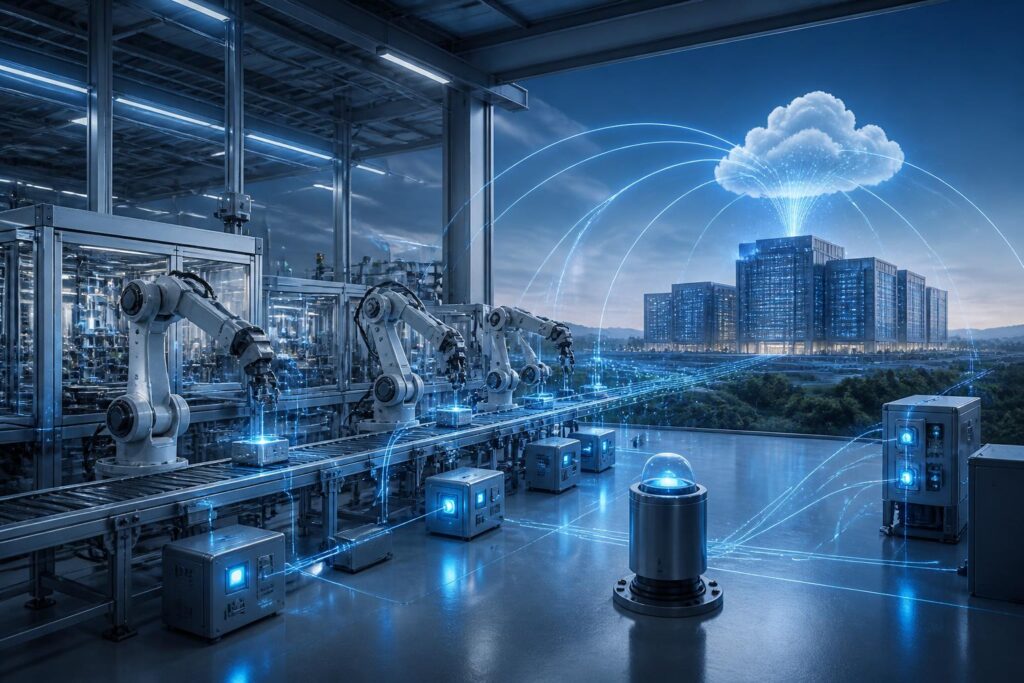
For many years, the familiar model for digital systems has been to transfer data from end devices to a data center or cloud platform for processing. This approach is suitable for tasks that do not require an immediate response, such as storing records, synchronizing data, or analyzing periodic reports. However, as the number of sensors, cameras, connected machines, and smart devices increases, transferring all data to a distant location can create significant latency, transmission costs, and operational pressure.
Edge computing has emerged as an approach aimed at bringing part of the processing capacity closer to where data is generated. Instead of sending all data to the cloud, a system can analyze, filter, or provide a response directly on the device, within the local network, or at a nearby processing node. The cloud still plays an important role in centralized storage, model training, management, and large-scale analysis, but it is no longer the only place where every task is performed.
How Does Edge Computing Work?
In an edge computing architecture, data is generated across multiple layers. It may come from sensors on a production line, cameras in a store, medical devices, means of transportation, or household appliances. Instead of transmitting all the data in its original form to a central facility, an edge device or edge server performs the initial processing steps. The system can remove duplicate data, detect notable events, convert formats, or send only the necessary results to the central platform.
The concept of the “edge” does not necessarily refer to one specific type of device. In a simple case, it may be a computing-capable controller placed right next to a machine. On a larger scale, an edge node may be a server in a building, store, factory, or network station. The boundary between end devices, access networks, and data centers may vary depending on the application’s requirements.
The core point of this model is to divide work appropriately. Tasks that require a fast response or must continue operating when wide-area connectivity is unstable should be processed close to the data source. Tasks that require data aggregation from multiple locations, use substantial resources, or support long-term reporting can continue to be performed in the cloud. Edge computing is therefore not a complete replacement for cloud computing, but rather a way of combining two infrastructure layers.
Why Are Businesses Interested in This Model?
The most noticeable benefit is reduced latency. When a system has to send a request across multiple networks before receiving a response, transmission and processing time can affect the user experience or operational efficiency. Processing at a node near the device shortens the distance data must travel. This is particularly useful for applications that need an almost immediate response, such as detecting anomalies on a production line, coordinating equipment in a warehouse, or supporting real-time interactive features.
Edge computing can also reduce the amount of data that must be transmitted to a central facility. A camera can generate a large volume of data if it continuously sends all images to the cloud. In many situations, the system only needs to determine whether an event requiring attention has occurred, then send a data segment or analysis result instead of continuously transmitting every frame. This approach can help businesses use bandwidth more efficiently, although actual costs still depend on the design, equipment, and storage requirements.
The ability to continue operating when a connection encounters problems is another important advantage. A production facility or point of sale can continue performing certain local functions even when it cannot connect to the central system. Once the connection is restored, the necessary data and status information can be synchronized according to predefined policies. However, this mechanism must be clearly designed to avoid data conflicts or incorrect decisions when the system is temporarily operating in an isolated state.
From a data governance perspective, processing at the edge can support the principle of collecting only what is necessary. Businesses do not necessarily have to store or transmit all raw data if the objective is merely to detect a signal, count an event, or check a condition. Reducing the scope of data being moved can help limit risks, but it does not mean that data at the edge is automatically secure. Edge nodes must still be protected, updated, and subject to access controls.
Industries That Could Benefit
In manufacturing, edge devices can receive data from machinery and perform inspections directly on the production line. The system can detect signs of abnormality, send alerts, or support stopping a stage according to configured rules. Analyzing data close to the machinery reduces dependence on connections to a central facility while also enabling faster responses than a process based solely on remote processing.
In retail and logistics, edge computing can be used to process data from cameras, temperature sensors, goods-tracking devices, and warehouse management systems. A store may need to identify the status of shelves or movement flows without continuously sending all image data outside the premises. In a warehouse, local processing nodes can help coordinate sensors and automated equipment, while aggregated data is still sent to the centralized management system.
In transportation and urban infrastructure, the need for rapid responses makes processing close to the data source particularly noteworthy. Edge nodes can support analysis of equipment status, recognition of abnormal situations, or activity coordination according to predefined rules. Nevertheless, systems that directly affect human safety must be designed with backup mechanisms, rigorous testing, and clearly defined limits on the scope of automation.
In offices and buildings, edge computing can be combined with sensors for temperature, air quality, energy, or space utilization. Data can be processed locally to adjust certain devices according to actual needs, while aggregated information for long-term analysis can be sent to a central system. This model enables on-site responses without requiring every decision to depend on an external service.
Challenges That Cannot Be Overlooked
Infrastructure distribution is the biggest challenge of edge computing. A centralized data center is generally easier to standardize in terms of hardware, software, and monitoring procedures than dozens or thousands of nodes deployed across many locations. As the number of nodes grows, businesses must track software versions, device status, storage capacity, connection quality, and signs of abnormality at each deployment point.
Security must also be considered from the outset. Edge nodes may be located in places that are more difficult to control than data centers, while also having to receive data from many different devices. Businesses need to authenticate devices, encrypt data appropriately, apply least-privilege access controls, log activities, and establish secure update procedures. If a node is compromised, the system must limit an attacker’s ability to extend access to other devices or services.
Distributed data governance also raises questions about consistency. When a node temporarily loses connectivity, it may continue recording and processing data according to its local state. Afterwards, the system must determine which data takes priority, how duplicate records should be handled, and how conflicting decisions should be resolved. This is not merely a technical issue; it also involves business processes and accountability when the system produces results that differ from the data held at the central facility.
Initial investment costs should not be overlooked either. Businesses may have to purchase edge devices, deploy management software, build backup connections, and train operating teams. Looking only at the benefits of reduced bandwidth or lower latency without calculating total lifecycle costs can lead to inaccurate decisions. A good architecture needs to balance real-time requirements, device capabilities, the importance of the application, and the ability to operate over the long term.
A Suitable Approach to Deployment
Businesses should start with a specific problem rather than deploy edge computing as a trend. Suitable applications often require rapid responses, generate large volumes of data, need to operate locally, or face connectivity limitations. A pilot project with a limited scope can help evaluate stability, costs, monitoring capabilities, and compatibility with existing processes.
Next, it is necessary to clearly determine which data will be processed at the edge, which data will be sent to the central system, and how long data will be stored at each layer. These rules should be tied to business objectives, security requirements, and governance responsibilities. At the same time, the system must support remote observability, automatically issue alerts when a node fails, and recover according to tested procedures.
In the long term, edge computing can deliver its full value only when it is treated as part of an overall architecture. Devices, networks, cloud platforms, analytics systems, and operating teams need to follow compatible principles. Businesses should also avoid becoming completely dependent on a single processing model. The ability to migrate, scale, and replace individual components will help the infrastructure adapt more effectively as needs change.
In Which Direction Will Edge Computing Develop?
The development of edge computing is linked to the trend of connecting more and more devices to networks and the need to process data close to real time. However, the future of this model does not lie in pushing every task down to the smallest possible device. Its practical value lies in how work is distributed among end devices, edge nodes, and the cloud so that each layer handles the tasks suited to its capabilities and objectives.
As management tools improve, deploying and updating distributed nodes may become more consistent. Analytical models may also be optimized to operate on limited hardware, while aggregated data continues to be sent to a central facility to track trends and improve the system. Nevertheless, every technological advance still needs to be accompanied by operational discipline, access control, and an assessment of the impact on users.
Edge computing is not a solution to every data problem. For simple tasks, tasks with few time requirements, or tasks that need centralized processing, a traditional cloud architecture may still be a reasonable choice. But in environments where latency, local operability, and data transmission costs play an important role, processing data close to where it is generated offers a design approach worth considering. The value of edge computing ultimately depends on whether a business clearly understands the problem it needs to solve and can build an architecture that balances performance, security, and operability.
