


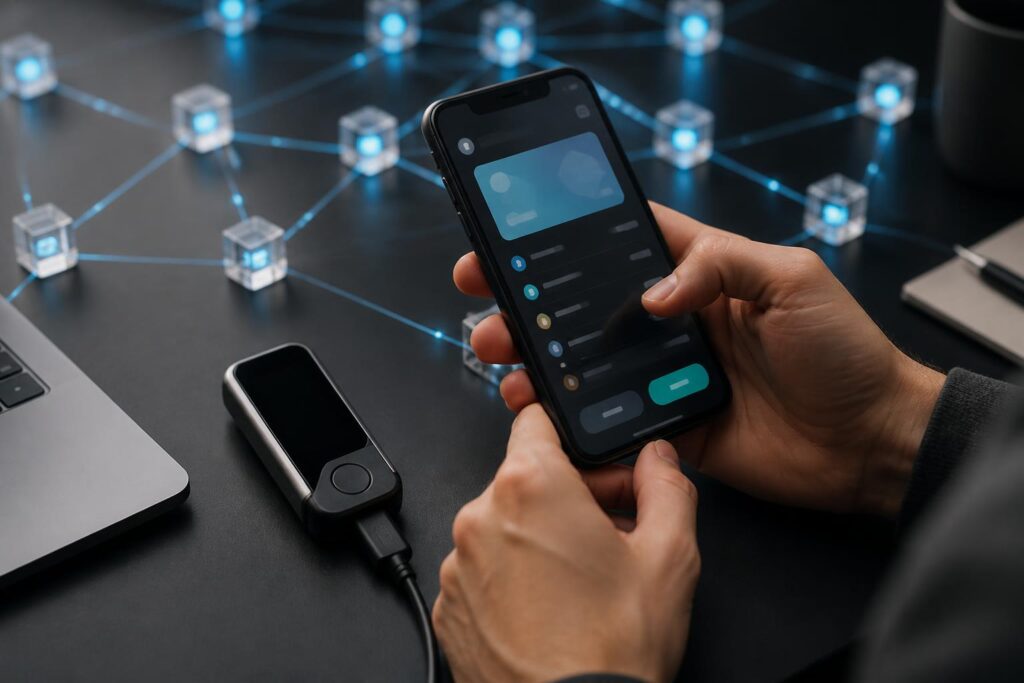
Many people enter the cryptocurrency market by creating an account on an exchange, depositing funds, and seeing a balance displayed on the screen. Based on that experience, quite a few people imagine a crypto wallet as being similar to an ordinary electronic wallet, where assets are stored and can be taken out at any time. This understanding is easy to grasp but not entirely accurate. In most blockchain systems, a wallet does not directly contain coins inside a device. Instead, it manages cryptographic keys that allow users to prove control over assets recorded on the network.
This distinction is not merely technical. It determines who has the authority to make transactions, who bears responsibility when access information is lost, and how users must balance convenience with the degree of autonomy they retain. A wallet can make operations faster, but it can also introduce risks if users sign the wrong transaction, expose their private key, or access counterfeit software. Therefore, before choosing a type of wallet, it is important to understand what the wallet does and what one is actually controlling.
Crypto Wallets Manage Keys Rather Than Store Coins
On a blockchain, balances are generally recorded in the network’s data. A wallet address is a form of public identifier that can be used to receive assets, while a private key is secret information used to create a signature confirming that a transaction was made by the person with the corresponding control rights. A wallet provides an interface for creating, storing, or using this information without requiring users to handle all the cryptographic calculations themselves.
One way to think of a wallet address is as a mailing address, while a private key is like the authority to sign an order sending the mail somewhere else. Making a receiving address public does not usually mean losing control, but revealing a private key is a serious problem. Anyone who knows the private key can create a valid signature, and the network cannot distinguish between the original owner and someone who has obtained the information.
In many wallets, users are given a recovery phrase consisting of multiple words according to a particular standard. This phrase can generally recreate the keys and addresses associated with a wallet. Therefore, it is not an ordinary password to be entered every day, nor is it a note that can be casually sent to someone else. Whoever possesses the recovery phrase may be able to restore access to the assets, depending on how the wallet and network are designed.
How Do Custodial and Self-Custody Wallets Differ?
Custodial wallets typically appear when assets are held in an account at an exchange or intermediary service. The service provider manages the keys on behalf of the user, while the user accesses the account through a password, additional authentication, or other security mechanisms. This model is easy to use, suitable for beginners, and often supports buying, selling, converting, or recovering an account according to the platform’s procedures.
However, a balance displayed in a custodial account does not necessarily mean that the user directly holds the keys to those assets. The ability to withdraw funds, transfer assets, or use certain services may depend on the provider’s rules, operational status, and verification procedures. This is a trade-off between convenience and autonomy. Users should not assume that a platform will always be able to process every request immediately, or that logging into an account is equivalent to controlling the blockchain keys.
Self-custody wallets, by contrast, give users control over their private keys or recovery phrases. Users can sign transactions directly and do not need an intermediary to approve each operation. This expands control but also transfers most of the security responsibility to the individual. If the recovery phrase is lost, information is entered into malicious software by mistake, or a fraudulent transaction is signed, resolving the problem is generally not as simple as requesting a password reset from an online service.
No type of wallet is ideal for everyone. Someone who trades frequently may prioritize speed and convenience, while someone holding assets for the long term may place greater importance on storage that is separated from the online environment. The right decision should be based on the value of the assets, frequency of use, personal security capabilities, and level of understanding of the operations to be performed.
Hot Wallets, Cold Wallets, and the Limits of This Classification
A hot wallet is a wallet that is regularly connected to the internet, such as a mobile application, browser extension, or computer software. Because it can be accessed quickly, a hot wallet is convenient when users need to interact with blockchain applications, send and receive assets, or sign transactions. The downside is that the device and online environment may be affected by malware, fake websites, untrustworthy extensions, or phishing schemes.
Cold wallets generally refer to methods of storing keys in a less connected environment, including dedicated hardware devices or offline storage. Separating keys from the computer and browser in use can reduce certain internet-related risks, but it does not make assets invulnerable. Users can still be tricked into providing their recovery phrase, purchase an untrustworthy device or software, or approve the wrong transaction because they did not carefully check the information displayed.
Therefore, “cold wallet” should not be viewed as a label that guarantees absolute safety. Security comes from the tool, the procedures, and the user’s behavior. Even a good device can lead to a loss of control if the recovery phrase is photographed, stored on a cloud service, or entered into an unfamiliar website. Conversely, a hot wallet installed from a trustworthy source, protected by a clean device, and used with appropriate limits can meet certain needs, although caution is still required.
Points Where Risks Commonly Arise When Using a Wallet
The first risk is losing or exposing the recovery phrase. Users should not send it through messages, email, or online forms, and should not enter it into a website simply because someone claiming to be support staff requests it. Legitimate services do not need users to disclose information capable of recovering an entire wallet. Storage should be planned with the aim of limiting unnecessary copies, avoiding environments that may be accessed without authorization, and ensuring that trusted users still know how to recover access when necessary.
The second risk comes from installing counterfeit applications. The name, icon, and interface of a well-known wallet can be copied. Users should check the download source, developer, update information, and permissions requested by the application. Searching online and immediately clicking the first result can also lead to an advertising page or a fake website. Caution does not mean placing absolute trust in any interface; users should verify information through official channels and limit the installation of unnecessary software.
The third risk lies in the transaction itself being signed. A website may ask to connect to a wallet on the grounds that the user is receiving a reward, participating in an event, or verifying an account. After connecting, the user may be asked to sign a message or grant permission to a contract. Not every signing request is an immediate instruction to transfer assets, but users need to understand the content and scope of the request before approving it. If they do not know what permissions the transaction grants, which assets may be affected, or how those permissions can be revoked, the safer choice is to stop and investigate.
The fourth risk is sending funds through the wrong network, to the wrong address, or as the wrong type of asset. One address may look very similar to another, while blockchain transactions are often difficult to reverse once confirmed. Users should carefully check the recipient address, network, asset type, and associated fees. For a transaction of significant value, sending a small test amount first can help identify procedural errors, although it does not eliminate every risk.
Building a More Practical Wallet-Use Process
Effective security habits often begin by separating purposes of use. A wallet intended for frequent interactions does not necessarily need to contain all of one’s assets. Separating funds used daily from long-term holdings can limit the damage if the trading wallet is compromised. This arrangement also helps users more clearly identify which wallet is connected to which application and which assets actually need to be placed in an online environment.
Before transferring a large amount, users should follow a fixed series of checks rather than relying solely on instinct. This checklist might include verifying the address, network, destination application, transaction details, fee level, and permissions being requested. When someone pressures the user to act immediately, promises guaranteed returns, or threatens that the account will be locked unless the recovery phrase is provided, that is a sign to stop and verify the matter through an independent channel.
It is also necessary to plan for situations in which the device is lost or the user cannot access the account. This plan should specify where recovery information is stored, who may be authorized in special circumstances, and how recovery capability can be tested without exposing secret data. However, all testing must be carried out in a controlled environment, because entering a recovery phrase into an untrusted device can create new risks.
Autonomy Always Comes with Responsibility
The greatest value of self-custody is the ability to control assets directly without being completely dependent on an intermediary. But autonomy does not mean that users are free from responsibility. A blockchain can confirm a valid signature without assessing the motive behind it. If a wallet owner voluntarily grants permission or transfers funds to the wrong address, the network generally cannot distinguish that transaction from a legitimate one.
Therefore, knowledge about wallets should be regarded as part of digital financial literacy, not merely as the skill of installing an application. Users should begin with an amount appropriate to their risk tolerance, practice with small transactions, and document their own procedures. Once they understand that a wallet is a tool for managing keys, not a box that stores money, they will take a more practical approach to security, custody, and applications on the blockchain.
The cryptocurrency market can change rapidly, but the fundamental principles of using a wallet remain relatively clear: protect recovery information, check software and transactions, separate purposes of use, and never grant more permissions than one understands. No device or application can replace a careful process. A good wallet only truly serves its purpose when the user knows what they are signing and who controls the assets.
