


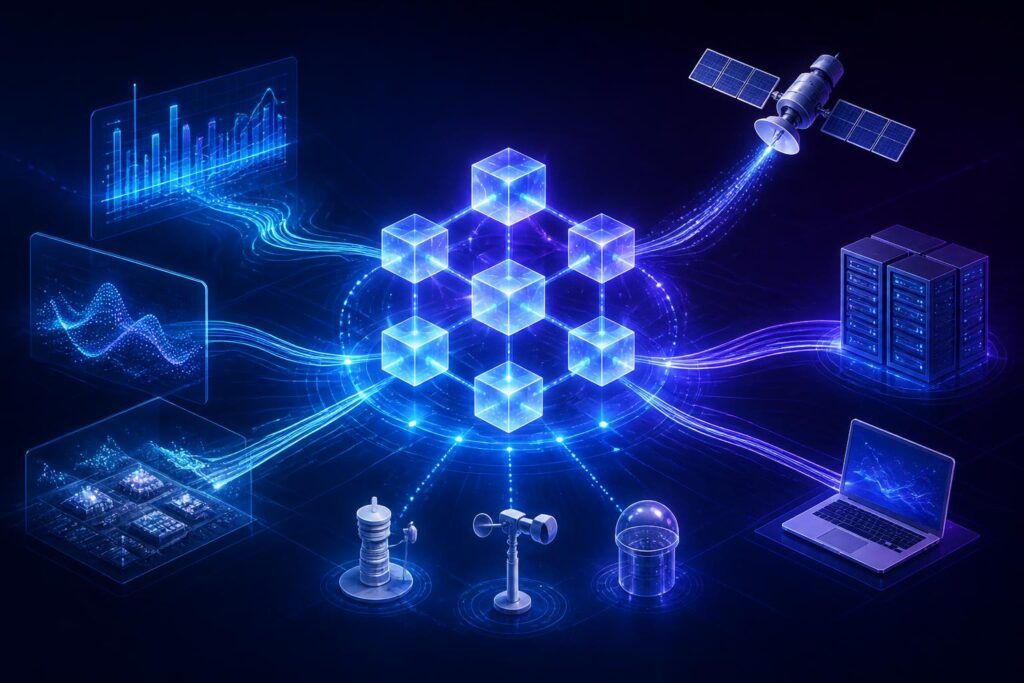
Blockchain is often described as a system capable of recording and verifying data without a single coordinating center. However, a blockchain network itself directly knows only what happens within it, such as wallet balances, confirmed transactions, or the state of a smart contract. When an application needs to know an asset’s price, the weather, the result of a match, a delivery status, or a real-world event, that data must be brought into the network through a suitable intermediary mechanism. This mechanism is commonly called a blockchain oracle.
An oracle is not a separate type of cryptocurrency, nor is it always an independent product. It is a general term for a system that provides data from outside to a blockchain or transfers information from a blockchain to other systems. Oracles play an important role because they expand the scope of smart contracts, but they also raise questions about reliability. If the input data is wrong, a smart contract may execute its programmed logic correctly and still produce an incorrect result.
Why do smart contracts need external data?
A smart contract is a program that runs on a blockchain. It can automatically execute prewritten conditions, such as transferring assets when a transaction meets all requirements or distributing rewards according to a specific rule. The strength of this model is that the parties do not necessarily have to rely on a single organization to confirm each step. The network collectively verifies the state and executes the code according to agreed-upon rules.
However, a smart contract does not inherently know about events outside the chain. A weather insurance application may need rainfall data at a particular location. A decentralized finance platform may need an asset’s reference price to calculate its collateral ratio. A game may need a random result to distribute items. This information is not already present in the blockchain ledger. If each contract connects directly to a website, database, or individual server, the system will face numerous issues involving access rights, consistency, and the possibility of manipulation.
Oracles address this problem by collecting, verifying, and transferring data in a format that smart contracts can use. As a result, blockchains can interact with real-world events without turning the entire network into a system for collecting external data.
What steps does an oracle follow?
An oracle process usually consists of multiple layers. First, the system determines the type of data that needs to be provided and the sources that can be used. The data may come from one or more external sources, depending on the application’s design. Data-collection components then obtain the information, standardize its format, and send the result to the blockchain. The smart contract receives this data and executes its programmed conditions.
In a simple model, a single server provides data to the smart contract. This approach is easy to deploy but creates a centralized point of failure. If the server is interrupted, attacked, or deliberately sends incorrect data, the contract may be affected. Therefore, designs that emphasize decentralization often use multiple data sources or multiple independent providers. The system may compare the results, discard unusual values, and calculate an aggregate value before putting it on-chain.
However, multiple sources do not automatically mean absolute safety. If the sources all depend on the same database, obtain data from the same place, or share the same infrastructure, their actual level of independence may be lower than it appears. Evaluating an oracle therefore involves more than simply counting the number of providers; it also requires examining the data sources, the selection method, the authentication process, and the procedure for handling cases in which the sources produce different results.
Common types of oracles
Oracles can be classified according to the direction in which data moves. Oracles that bring data from outside into a blockchain are the most frequently discussed. This type is necessary for applications that use asset prices, weather information, shipping statuses, or other real-world conditions.
Conversely, an oracle can transmit information from a blockchain to the outside world. For example, an off-chain system may need to know that a transaction has been completed, that ownership has been recorded, or that a condition in a contract has been met. There are also software oracles, which obtain data from digital services; hardware oracles, which receive signals from devices or sensors; and cross-chain oracles, which help one blockchain network access the state or data of another.
Not every application needs the same level of decentralization. An internal experimental game may accept a centralized data source because its risk exposure is limited. By contrast, an asset-management application involving significant value requires stricter standards for continuity, verifiability, and response mechanisms when data is abnormal. The important point is that the design must be proportionate to the consequences if the data is incorrect or interrupted.
The greatest risks lie in the input data
Blockchain can protect the integrity of data after the data has been recorded, but it cannot prove by itself that the original data was correct. This issue is often expressed through the question: where does a decentralized system get its information, and who is responsible when that information is wrong?
The first risk is manipulation of data sources. A price feed may be interrupted, updated slowly, or affected by an unusual transaction. If a contract uses that price to liquidate assets or calculate a payment, even a short-lived discrepancy can have significant consequences. The second risk is data-transmission error. Data may be sent with the wrong unit, an incorrect decimal point, an incorrect timestamp, or may fail to be updated when market conditions change.
The next risk concerns continued operation. An oracle may temporarily stop because of an infrastructure failure, network congestion, or a software error. If the contract has no fallback mechanism, processing may come to a standstill. Conversely, if the contract continues using old data without recognizing the failure, it may make decisions based on outdated information.
In addition, the oracle’s governance mechanism also needs to be examined. Who has the authority to change data sources, update the software, adjust alert thresholds, or pause the system? Is this authority assigned to one individual, a governing group, or a voting mechanism? The answer directly affects the level of control and the ability to prevent abuse.
Criteria to consider when evaluating an oracle
Users and developers should not look only at the name or popularity of an oracle solution. The first criterion is the quality of its data sources. Are they suitable for the intended purpose, updated frequently enough, and capable of providing a history of the data for verification? Data that is suitable for reference may not be reliable enough for an automated financial decision.
The second criterion is how the system aggregates information. Using multiple sources can reduce dependence on a single point, but there must be a method for handling abnormal values and major discrepancies. Evaluators should also find out whether the data is timestamped, whether there is a mechanism for detecting stale information, and whether there are limits for situations in which the data fluctuates sharply.
The third criterion is auditability and transparency. A reliable system should be able to explain where the data comes from, how it is transferred onto the chain, and how governance rights are controlled. Transparency does not eliminate every risk, but it helps developers and users identify points of dependence before putting assets or important activities into the system.
Finally, there is the incident-response plan. A contract may pause when the data is no longer current, switch to a backup source, or require an additional confirmation step. These measures can make the process more complex, but they are often necessary for applications with serious consequences. Automation is truly useful only when it is accompanied by safety limits and the ability to recover.
Oracles and the limits of the promise of decentralization
Oracles show that a blockchain cannot be evaluated merely by checking whether data is on-chain. A system may be decentralized at the storage layer while still depending significantly on external data sources. This is not necessarily a flaw, because many applications must connect to the real world. The issue is that the extent of this dependence must be identified and disclosed.
In practice, a good design is usually a balance among decentralization, speed, cost, and operability. Increasing the number of data providers can improve resilience but also consume additional resources. Updating data too frequently can reduce latency but increase costs. A more cautious mechanism may limit errors but cause the application to respond slowly to changes. There is no single configuration that suits every situation.
For ordinary users, the key point to remember is that a smart contract is not a guarantee that every piece of information it uses is accurate. Before participating in a blockchain application, users should find out where the application gets its data, what happens when the data is interrupted, and who has the authority to intervene in the system. These questions are more practically valuable than simply looking at claims about speed or the degree of decentralization.
Conclusion
Oracles are an infrastructure layer that helps blockchains move beyond the scope of transactions and states recorded directly on-chain. Through oracles, smart contracts can respond to market data, real-world events, and information from other systems. But this bridge also becomes an area requiring oversight, because the accuracy of the outcome depends not only on the code but also on the data sources, verification procedures, and governance mechanisms.
When evaluating a blockchain application, users should view the oracle as a core part of the product rather than a peripheral technical detail. Understanding where the data comes from, how it is checked, and how the system responds when problems occur will help create more realistic expectations about the safety of automation on blockchain.
