


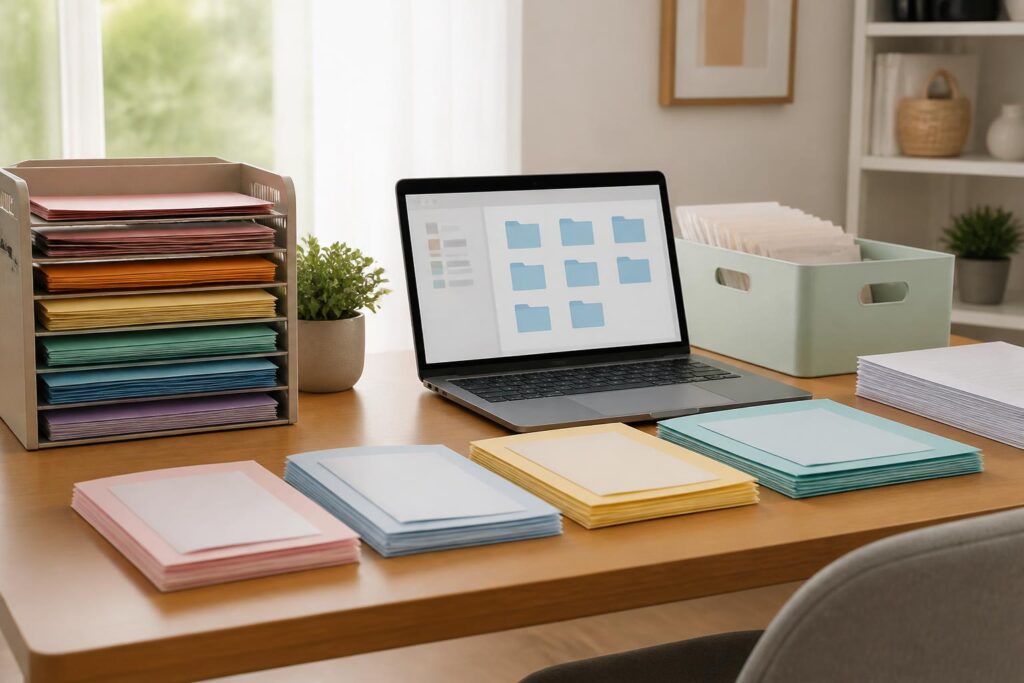
In many families, documents are often stored in a very improvised way. Bills are kept in drawers, contracts lie among old notebooks, medical records are mixed in with school materials, and copies of important documents may be scattered across several phones. This storage method may not cause problems when everything proceeds normally, but its weaknesses quickly become apparent when a document needs to be found within a short time.
A family records system does not need to be complicated, expensive, or dependent on specialized equipment. What matters is that every family member knows what groups the documents are divided into, where the originals are kept, how copies are stored, and when updates are needed. When the process is simple enough to maintain, managing paperwork becomes a manageable habit rather than a task that gets postponed.
Begin by Taking Inventory Instead of Buying Storage Boxes
A common mistake when organizing records is to buy a large number of folders, boxes, or filing cabinets before knowing what documents one actually has. A more effective approach is to gather all documents that may need to be kept in one temporary area, then take inventory of each group. You can start with drawers, bookshelves, handbags, desks, and boxes that have not been opened in a long time.
At the first stage, there is no need to read every line on every sheet of paper carefully. Simply identify the type of document, the person involved, and its level of importance. For example, some documents need to be preserved long-term because they relate to personal identity or ownership; some are needed only for a certain period; and others may be drafts, duplicates, or documents that no longer have any practical value.
It is advisable to prepare three temporary areas: items to keep, items to review, and items that can be discarded. For documents you are unsure about, set them aside rather than throwing them away hastily. After completing the main sorting, the family can review this group more carefully. Keeping undecided documents separate from important records reduces the risk of overlooking something and makes the organizing process easier to control.
Classify Documents by Purpose
A good system should reflect how the family actually uses its documents. Classifying them by paper color, size, or place of receipt is generally not very helpful when a document needs to be found. Instead, records can be divided into broad groups such as personal documents; housing and property; finances; health care; education and work; warranties or purchases; and a group of family documents that need to be reviewed periodically.
The personal documents group may include materials confirming information about each family member. The housing and property group may contain contracts, records related to the home, repair receipts, or long-term warranty documents. Financial records should be kept separate from ordinary documents because they often contain sensitive information. Medical records should also be organized by person to avoid confusion, especially when the family has young children or someone who needs regular health monitoring.
Too many folders should not be created at the outset. If a group contains only a few documents, they can be kept together in one large folder with divider sheets. As the number grows, that group can then be divided into smaller sections. A system with too many branches will make users spend time deciding where to put a document, making it easier for them to return to the habit of placing paperwork anywhere.
Separate Originals, Copies, and Documents in Progress
These three statuses need to be clearly identified. An original is a document that needs to be carefully preserved and should not be carried around unless necessary. A copy is used for reference, sending, or appropriate administrative procedures. A document in progress is paperwork that is missing information, needs to be signed, requires payment or a response, or calls for a next step.
Separate folders can be used for these three groups, even when they all belong to the same subject. For example, housing records may include an originals folder, a copies folder, and an “in progress” folder. This prevents unfinished documents from being mixed into long-term storage. Once a matter has been resolved, the related documents can be moved out of the in-progress area and placed in the appropriate group.
For important documents, it is advisable to make a brief note indicating where the original is stored and who is responsible for updating it. This note does not need to contain the document’s entire contents. Its purpose is to help other family members know where to look when the person who usually manages the records is not present.
Design a Consistent Naming and Labeling System
Record labels should be short, clear, and phrased consistently. If one folder is called “Home,” another is called “Apartment Documents,” and yet another is called “Housing Contracts,” someone searching may not know where to begin. The family should agree on group names that are easy for everyone to understand and avoid using symbols that only one person can interpret.
For digital documents, file naming is just as important as arranging paper documents. A file name may include the document type, the person involved, and the date, as long as the family applies the system consistently. Avoid generic names such as “new documents,” “scans,” or “documents to review,” because these names quickly lose their meaning as the number of files increases.
Digital folders should mirror the paper records system to a reasonable extent. If paper documents are divided into broad groups, electronic folders can use similar groups as well. This consistency reduces the time spent thinking when moving from paper to digital records and helps new family members understand the shared management system more easily.
Store Paper Records and Sensitive Information Securely
Paper records should be kept in a dry, clean place where they are unlikely to be disturbed and that is not somewhere people regularly retrieve items from. Important documents can be placed in separate folders, avoiding excessive folding or cramming too many papers into one place. A single box should not be used for all records if retrieving one document often causes the others to become disorganized.
Documents containing personal information, financial details, or health data need to be managed more carefully than ordinary documents. They should not be left where visitors to the home can easily see them. If the family has young children, the storage area should also be out of reach and arranged so that retrieving one document does not cause other papers to fall or go missing.
For documents that are no longer needed, consider how to destroy them without exposing personal information. Shredding sensitive documents or using a method appropriate to the family’s circumstances is safer than putting an intact sheet in the trash. Before disposing of a document, make sure it is no longer related to any ongoing obligation, transaction, or verification request.
Back Up Digital Documents Responsibly
Digitizing records reduces reliance on a single paper copy, but a scan does not automatically become a substitute in every situation. The family needs to distinguish between storing a reference copy and meeting the requirements of a specific procedure. When a document is needed, check the actual requirements to determine whether a paper original, a copy, or an electronic image is appropriate.
When creating a digital copy, check whether the entire content has been captured clearly, whether any corners of the paper are obscured, and whether the file can be opened normally. A few minutes of checking immediately after saving will be more useful than discovering that an image is blurry when it is needed. Files should also be placed in folders with a clear structure rather than simply left in a phone’s photo library.
Sensitive records should not be shared through channels or with people who do not need to know. When sending a document, review whether it is the correct file, the recipient is correct, and the purpose of sending is appropriate. If the device or storage account has security features, the family should use suitable protective measures and avoid sharing passwords casually.
Maintain the System with a Short Review Schedule
A storage system has value only when it is kept up to date. The family does not need to spend an entire day reviewing its records. A short period at suitable intervals may be enough to process new documents, return completed records to their proper places, and remove unnecessary duplicates. The important thing is not to let new paperwork accumulate into an unplanned pile.
During each review, you can ask a few simple questions: What group does this document belong to? Is it an original, a copy, or a document in progress? Is there a date when it needs to be reviewed again? Who needs to know where the document is kept? These questions help turn organizing into a repeatable process rather than something dependent on memory or inspiration.
If several people use the system, they should agree on one rule after taking out a record: return it to its proper place or clearly note where it is being kept. For documents in progress, the person responsible can leave a brief note about the next step. This is especially useful when a task takes several days and involves multiple family members.
The Value of a Simple System
Storing family records is not just about tidying up a cabinet. It is a way to reduce dependence on one person’s memory, limit rushed searches, and create clarity when the family has to handle unexpected matters. A good system does not need to look absolutely perfect; it needs to be easy to understand, easy to use, and flexible enough to change with the family’s needs.
The family can start with the group of documents causing the most trouble, such as financial records or medical documents, and gradually expand to other groups. When every document has a clearly defined place, status, and means of identification, management becomes considerably easier. At that point, organization is no longer merely a matter of appearance but becomes a practical way to prepare for everyday life.
