

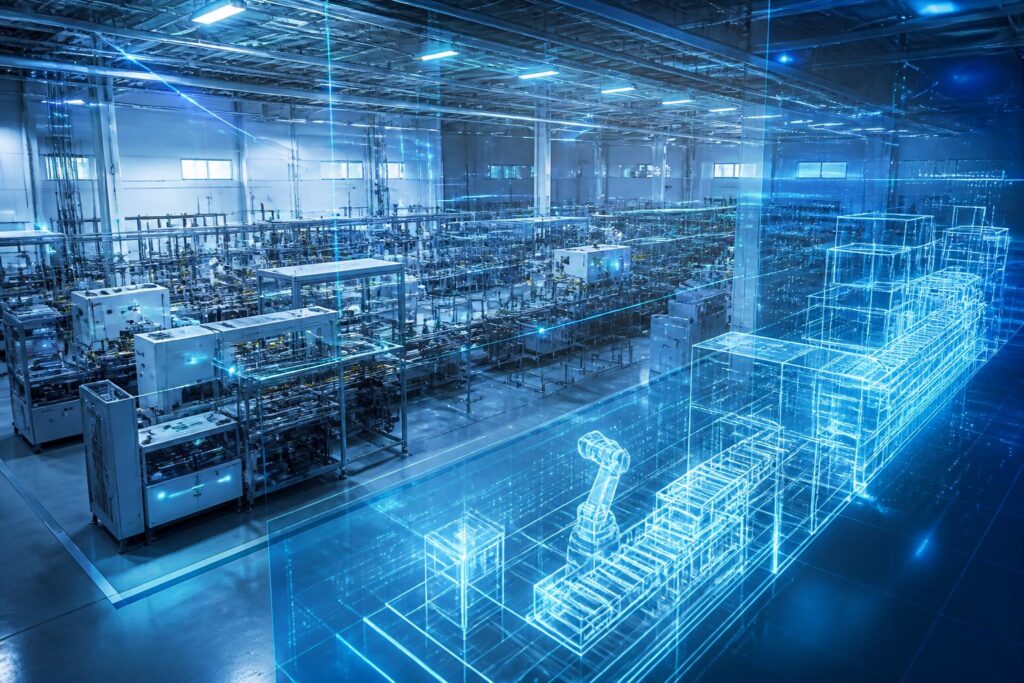
In many industries, operational decisions are often made based on reports of what happened in the past. A factory reviews the previous day’s production data, a building management unit checks monthly electricity consumption, while a logistics company analyzes routes after goods have been delivered. This approach remains necessary, but it is not always fast enough to respond to a constantly changing system. Digital twins are being developed to narrow that gap by creating a digital model that reflects the state and operation of a real-world object, process, or environment.
A digital twin is not simply a three-dimensional image or an electronic blueprint. Its value lies in the continuous connection between the digital model and the data generated by the physical object. When machinery vibrates abnormally, temperatures change, flow rates decline, or usage demand increases, that information can be fed into the model so operators can observe, analyze, and test multiple options. The goal is not to create a perfect replica in visual terms, but to build a sufficiently reliable tool to support understanding and action.
From Static Models to Systems Capable of Reflecting Reality
An engineering drawing shows how equipment was designed, while a maintenance database records incidents that have already been addressed. A digital twin combines more layers of information. It may include design specifications, sensor data, operating history, environmental conditions, maintenance status, and rules related to the process. As a result, users can do more than view an object or production line in a static state; they can also track how the system operates over time.
For example, a packaging line may be fitted with sensors that monitor speed, temperature, vibration, and downtime. Data from the sensors is fed into an analytics platform, where the digital model represents the condition of each component. If a motor shows signs of deviating from its normal operating range, the system can flag the area for inspection. The final decision still belongs to the technician, but they have more context to prioritize the work instead of waiting for the equipment to fail completely.
On a larger scale, a digital twin can describe an entire building, cargo port, water supply system, or urban area. In that case, the challenge is no longer just monitoring a single piece of equipment, but analyzing the relationships among many components. A change in the elevator operating schedule may affect electricity consumption. Adjusting vehicle routes may influence delivery times, traffic density, and warehouse demand. A digital model helps relevant teams observe the same overall picture instead of working with separate data tables.
Three Important Value Areas of Digital Twins
The first and most immediately apparent application is monitoring. Rather than manually checking each piece of equipment or waiting for periodic reports, operators can track indicators close to real time. A control panel can display equipment currently in operation, areas showing signs of abnormality, and indicators that have exceeded their thresholds. Consolidating data helps shorten the time needed to detect problems, particularly in environments with many distributed assets.
The second value area is condition-based maintenance. Under traditional methods, equipment is often maintained according to a fixed schedule or repaired after a failure occurs. A fixed schedule may lead businesses to replace components while they still have useful life, while post-failure repairs typically bring downtime and additional costs. A digital twin does not completely eliminate these two risks, but it can support condition assessment based on real-world data. Maintenance staff can combine sensor signals with repair histories and technical guidelines to decide on a more appropriate time for inspection.
The third value area is simulation before making changes. This is what distinguishes a digital twin from an ordinary tracking table. Businesses can test adjustments to production-line speed, changes to operating schedules, equipment rearrangements, or resource-allocation plans on the model before affecting the real system. Simulation does not guarantee that real-world results will be exactly the same, but it helps identify certain conflicts and foreseeable consequences. As a result, decisions can be prepared on a clearer basis rather than relying solely on experience or guesswork.
More Data Alone Does Not Make a Good Digital Twin
One common misunderstanding is that simply installing a large number of sensors and uploading the data to a platform is enough to create a digital twin. In reality, the data must match the operational objective. A project intended to predict motor condition will require different measurements from a project aimed at optimizing a building’s energy use. If the data is discontinuous, inconsistent, or incorrectly linked to equipment, the model may produce an inaccurate picture even when the volume of data is very large.
Data quality also concerns naming conventions, units of measurement, and recording times. Two departments may use different codes for the same piece of equipment or record temperature according to different conventions. Without standardization, connecting the data becomes difficult and the analytical results can easily cause confusion. Therefore, building a digital twin often requires a business to review its existing data systems, identify which sources are reliable, and clearly define who is responsible for maintaining each category of information.
The model also needs an appropriate scope. A system that is too simple may overlook important factors, but a system that tries to describe every detail from the outset will be costly and difficult to operate. A practical approach is to begin with a process involving a clearly defined problem, such as reducing downtime or controlling energy consumption, and then expand once its value has been demonstrated. A digital twin should develop according to usage needs rather than become a technology project detached from business operations.
The Role of Artificial Intelligence and Cloud Computing
Artificial intelligence can add pattern recognition, anomaly detection, and forecasting capabilities to a digital twin. Using historical data, an analytical model can identify signs that commonly appear before a shutdown or indicate relationships between operating conditions and energy consumption. However, AI produces meaningful results only when the input data is sufficiently suitable and users understand the model’s limitations. An alert should not be treated as an absolute conclusion, but as a signal for people to investigate and make a decision.
Cloud computing helps store and process data from multiple locations while enabling teams to access the same model. This is an advantage for businesses with distributed factories, warehouses, or assets. Even so, not all data should be placed in the cloud. Systems requiring very fast responses or containing sensitive information may need to process some data at the location where it is generated. A combination of on-premises servers, edge devices, and cloud platforms is often more suitable than relying on a single option.
Questions of Safety and Responsibility
When a digital twin is connected to a real system, information security becomes a requirement that cannot be taken lightly. Operational data may reveal production capacity, maintenance schedules, energy consumption, or the condition of infrastructure. If an account is compromised or data is altered, operators may make incorrect decisions. Businesses need to control access permissions, protect communication channels, record change histories, and isolate critical systems from unnecessary connections.
It is also necessary to distinguish between the right to observe and the right to control. A model used only for monitoring carries different risks from a system that can automatically send commands to machinery. Before allowing automation, a business should clearly determine which situations require human approval, which can be handled according to predefined rules, and how to recover when data is incorrect or a connection is interrupted. Responsibility cannot be assigned entirely to an algorithm, because operational decisions are always connected to people, processes, and real-world contexts.
Compatibility is another challenge. Older equipment may not support modern protocols, while software from different suppliers may not necessarily exchange data smoothly. Replacing an entire system solely to support a new model is often impractical. Projects therefore need to account for intermediate connectivity layers, phased upgrade plans, and data standards that can be used over the long term. A useful digital twin does not necessarily have to be built with the latest technologies; it must be able to connect with the existing reality.
Implementing Digital Twins Through Specific Problems
Businesses that want to get started should choose a problem with clear evaluation metrics. This could be equipment downtime, the number of unnecessary inspections, electricity consumption, or the time required to process an order. The implementation team should then list the data sources, identify gaps, and agree on how results will be measured. A small model that answers a specific operational question is often more valuable than a large platform that users do not know how to use.
Personnel are also a decisive factor. Operations engineers understand the equipment but may not be familiar with data analysis; technology teams understand the platform but may not fully understand fluctuations in the real-world process. The two groups need to work together from the stage of defining objectives. Training end users, documenting procedures for handling alerts, and collecting feedback after each phase will help the model become increasingly aligned with actual needs.
Over the long term, a digital twin can become an intermediary layer that helps a business connect design, operations, maintenance, and planning. It supports a shift from reacting after failures to early observation, controlled experimentation, and continuous improvement. However, this technology is not an automatic solution to every problem. If processes lack discipline, data is unreliable, or objectives are unclear, a complex digital model will only increase costs and confusion.
Digital twins are noteworthy because they move data beyond its role as a reporting tool and make it part of the decision-making process. When built at an appropriate scale, properly protected, and placed in the hands of people who understand real-world operations, such a model can help an organization see a system more clearly before changing it. Its ultimate value does not lie in visual imagery or in the name of the technology, but in its ability to turn fragmented information into well-founded, safe, and operationally appropriate action.
