


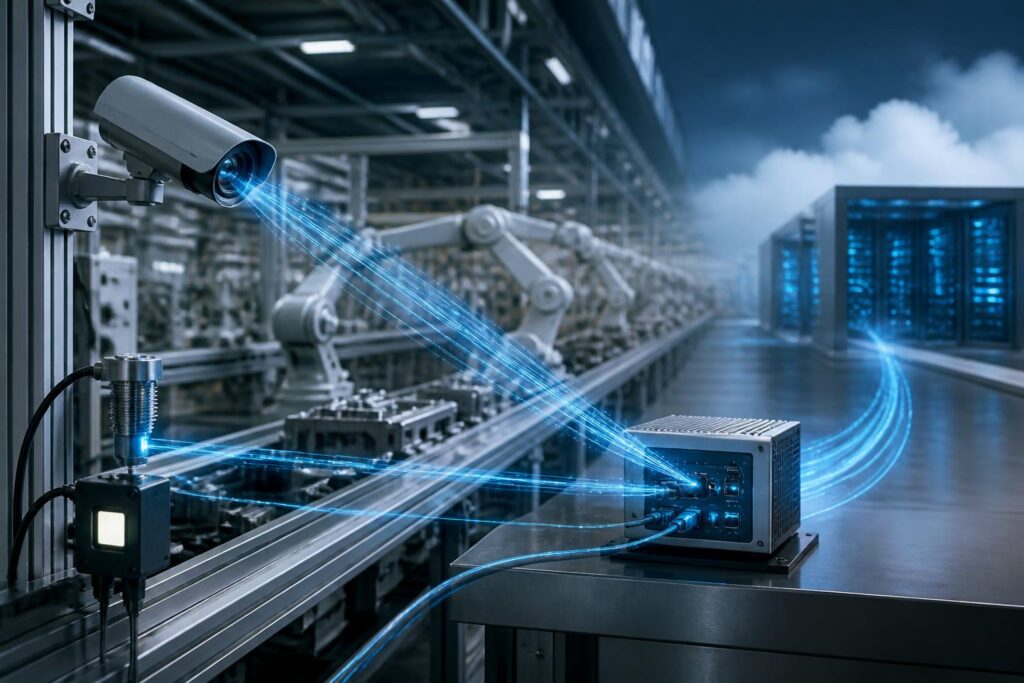
Most experiences with artificial intelligence today are tied to large data centers. Users send questions, images, or files to a remote system, the servers process them, and then return the results to the device. This model makes it possible to take advantage of powerful computing capacity, but it is not always suitable. When a camera needs to detect a problem in a very short time, when a production line cannot depend entirely on an Internet connection, or when data contains sensitive information, sending everything to the cloud can create unnecessary latency, costs, and risks.
Edge AI, as it is commonly called, has emerged to address part of this problem. Instead of processing only on centralized servers, edge AI brings the model or part of the inference process closer to where the data is generated. This source could be a phone, personal computer, camera, sensor in a factory, vehicle, medical device, or on-site control system. This approach does not eliminate cloud computing; rather, it divides the work between devices and servers in a way that suits the intended use.
How Does Edge AI Work?
In a conventional system, a sensor or device records data and then transmits it to a server. The server runs an AI model, generates a result, and sends a command or notification back. With edge AI, a trained model can be deployed directly on the device or on a computer located near it. Inference—the step of using a model to classify, predict, or recognize new data—takes place right where the data is generated.
For example, a camera in a factory can analyze images to identify products that are misaligned. If the only requirement is to issue an on-site alert, the camera or a nearby computer can process the images without sending the entire continuous video stream to an external server. The cloud system can still receive aggregated results, unusual cases, or selected data for long-term monitoring. In this way, each component handles the tasks suited to it instead of transmitting all data in one fixed direction.
Edge AI also comes in different levels. A small device may perform only simple tasks such as detecting keywords, recognizing movement, or classifying sounds. A more powerful on-site computer can process images, video, or multiple types of sensor data. In some architectures, the device performs an initial filtering step and then sends condensed data to the cloud for deeper analysis. Therefore, “at the edge” does not necessarily mean that all AI operations take place completely offline.
Notable Benefits
The most obvious benefit is reduced latency. When results need to appear almost immediately, sending data over a network to a distant data center and waiting for a response may not be suitable. Driver-assistance systems, safety-monitoring devices, and machinery controllers often need to respond to conditions occurring on-site. Processing data close to its source shortens the path the information must travel, although actual speed still depends on the hardware, model, and software design.
Edge AI can also reduce the amount of data that needs to be transmitted. Video from cameras, continuous audio signals, and time-based sensor data can generate substantial traffic. Instead of sending all the data, a device can transmit only events, recognition results, relevant data segments, or summarized information. This is particularly useful in places where connectivity is slow or unstable, or where data transmission is expensive.
The ability to operate during a loss of connectivity is another advantage. If an important function depends entirely on a remote server, a network failure can interrupt the entire process. A model deployed on-site can still perform core tasks while the connection is interrupted. However, the degree of independence must be clearly defined. A device may continue detecting events, but it may not be able to synchronize data, update the model, or coordinate with other systems without a network.
In terms of privacy, processing at the edge can help limit the transfer of raw data outside the device. A phone can analyze speech directly on the device, or a system can convert images into statistical results before storing them. This is a measure that supports data protection, not an absolute guarantee. Data can still be accessed if the device is poorly protected, the software contains vulnerabilities, or management procedures are inadequate.
Hardware and Management Trade-offs
Bringing AI to edge devices is not as simple as copying a large model from the cloud onto a machine. On-site devices typically have more limited memory, processing capacity, and power supplies. As a result, the model needs to be optimized to fit the available space and consume fewer resources. Techniques such as reducing numerical precision, removing less necessary components, or designing lightweight architectures can be used, but each choice requires an assessment of its impact on the quality of the results.
A smaller model may respond quickly and run on a wider range of devices, but it may be more likely to miss complex cases. Conversely, larger models generally have stronger processing capabilities but require more powerful hardware, consume more energy, and are harder to deploy at scale. Therefore, the important question is not which model is the largest, but what level of accuracy is actually necessary for the specific task.
Managing hundreds or thousands of devices is also a major challenge. Each device must be authenticated, have its software updated, be monitored, and be protected from unauthorized interference. When an AI model is updated, an organization must know which version is running where, whether the results have changed, and whether the device has sufficient resources to receive the update. Without proper procedures, distributing AI can increase complexity rather than reduce the operational burden.
Cybersecurity needs to be considered from the outset. Devices deployed in the field may be easier to access than servers in a data center. Malicious actors may try to extract the model, alter the software, tamper with input data, or send false signals to deceive the system. Measures such as encryption, access control, secure boot, logging, and software integrity checks need to be combined according to the level of risk. Local processing should not be treated as a reason to ignore basic security requirements.
When Is Edge AI Suitable?
This technology is most suitable when response time matters, data is generated continuously, or connectivity is unreliable. In manufacturing, edge AI can support quality inspection, detect signs of abnormal machinery behavior, and monitor processes. In retail, a system can analyze shelf conditions or customer traffic at an aggregated level, provided that the organization clearly defines the purpose and limits of data use. In agriculture, field sensors can process some environmental data before sending the necessary information to a management system.
On personal devices, edge AI can support speech recognition, image processing, content organization, or certain features that do not require a continuous connection. For applications involving private information, users have additional reasons to care about where data is processed, how long it is stored, and whether it is sent to third parties. These are questions of design and policy that cannot be answered simply by a product’s name.
Conversely, edge AI is not the optimal choice for every problem. Tasks that require very large models, data aggregated from many sources, or intensive computing power may still be better suited to the cloud. An effective system often combines multiple layers: the device handles immediate responses, a nearby server coordinates more demanding tasks, and the cloud stores data and supports long-term training and analysis.
How to Evaluate an Edge AI Project
Before deployment, an organization should start with operational requirements rather than follow technology trends. It needs to determine which results must be available and within what time frame, what data actually needs to be collected, under what conditions the devices will operate, and what happens when the network is interrupted. These questions help distinguish a genuine need from an idea that is merely attractive in a demonstration.
The next step is to evaluate both the quality of the model and the system as a whole. A model with high accuracy in a test environment may not perform similarly when lighting, noise, camera angles, or user habits change. It is necessary to examine cases that are prone to error, monitor the false-alert rate, and determine when human intervention is required. For decisions with significant effects on safety, finances, or individual rights, AI should be placed within an appropriately supervised process rather than used for unconditional automation.
Costs must also be calculated across the entire life cycle. In addition to the initial hardware, there are costs for electricity, connectivity, maintenance, replacement, model updates, storage, and incident response. A solution that is inexpensive to purchase but difficult to update or impossible to scale may become costly later. The ability to integrate with existing systems and the plan for retrieving data when the system is retired are also criteria that should not be overlooked.
The Trend Toward Distributed Processing Responsibilities
Edge AI shows that AI development does not take place only in large cloud-based models. Processing capacity is being distributed across multiple layers of devices and infrastructure. This distribution can change how products are designed: developers must pay simultaneous attention to algorithms, hardware, connectivity, security, privacy, and the experience of using the system when it encounters failures.
For users, what matters is not memorizing a new term, but understanding where their data goes. When using a device with AI features, users should look for information about whether processing takes place on the device or on a server, whether the data is retained, whether the feature works offline, and how to disable or manage access permissions. For businesses, edge AI should be viewed as a component of the overall information architecture, not as an independent device added at the very end.
Edge AI does not replace the cloud, nor does it automatically make a system safer, more private, or more efficient. Its value lies in placing the right processing in the right location. When requirements for speed, continuity, and data control are considered alongside hardware limitations and security risks, edge AI can become a practical layer of infrastructure. A balanced approach between local and centralized processing will determine whether this technology creates lasting benefits or merely becomes a new slogan.
