


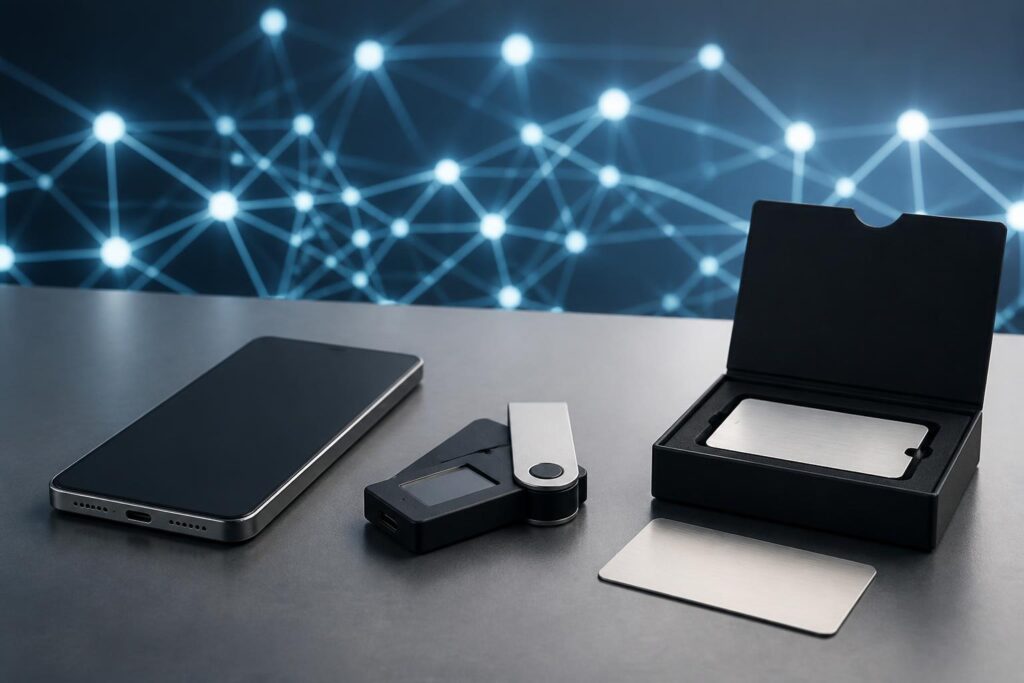
In the blockchain ecosystem, the phrase “not your keys, not your assets” is often used to describe the difference between keeping assets on an intermediary platform and managing them yourself with a personal wallet. However, self-custody is not simply a matter of downloading an application, creating an account, and transferring funds into it. It is a different responsibility model in which users directly control access while also having to protect the information that can unlock their assets.
A blockchain wallet does not store money in the way a physical wallet holds cash. The assets remain recorded on the network, while the wallet provides tools to prove control through cryptographic keys. Therefore, choosing a wallet, storing recovery information, checking addresses, and confirming transactions all have important implications. A careless action can cause users to sign the wrong transaction, grant inappropriate permissions, or lose access without a simple way to recover it.
What Does a Blockchain Wallet Really Manage?
At a conceptual level, a blockchain wallet is generally associated with two types of keys. A public key can be used to generate an address for receiving assets and can be shared with others. A private key is secret information used to create a signature confirming that a transaction was carried out by the person with the corresponding control rights. Others may know the public address without being able to practically derive the private key from it, but if the private key is exposed, control may be transferred.
Many applications today do not display the private key directly but instead provide a recovery phrase consisting of multiple words. This phrase often functions as a copy that can recreate the wallet’s set of keys. Therefore, it is not an ordinary password and should not be treated as a verification code that can be entered into any form. Whoever possesses the recovery phrase essentially holds the means of accessing the wallet, regardless of which phone or computer the original application was installed on.
The key point to remember is that a wallet address can be shared to receive assets, while the private key and recovery phrase must be kept confidential. These two groups of information serve entirely different functions. Confusing them is common among new users who copy a long string of characters without checking its purpose.
Self-Custody Provides Control but Does Not Eliminate Risk
Self-custody wallets allow users to interact directly with blockchain networks and decentralized applications without necessarily depending on a custodian. Users can decide for themselves when to transfer assets, connect to applications, and manage their keys. This is an important benefit for those who want to reduce their dependence on an account with an intermediary platform.
In return, responsibility also shifts to the user. If a user forgets the password for a centralized service, they may sometimes be able to go through an identity-recovery process. With a self-custody wallet, losing the recovery phrase or exposing the private key can lead to more serious consequences. No customer-service department can automatically reverse a transaction that has been confirmed by the network, and sending assets by mistake to an unsuitable address usually cannot be handled like a traditional bank transaction.
This does not mean that self-custody wallets are always safer in every situation. The level of security depends on how users create their wallets, protect confidential information, interact with websites, and check transaction details. Direct control only provides value when accompanied by disciplined operating habits.
Risks Often Begin During the Recovery Process
The moment a wallet is created is one of the stages requiring the greatest caution. The recovery phrase should be generated in a trusted application and recorded in a way that prevents others from seeing it. Taking screenshots, sending it by email, storing it in a chat, or syncing it to a cloud service can increase the risk of the information being copied. A device with malware can also cause confidential data to be collected without the user realizing it.
Backups should be kept somewhere protected against loss and with limited access. A single copy may be at risk from damage, fire, flooding, or misplacement; but too many copies in multiple locations expand the number of points where the information could be exposed. Each person needs to consider their own circumstances and choose an approach that balances recoverability with security.
It is also important to distinguish between protecting recovery information and memorizing it. An approach based solely on memory can become dangerous if the user forgets part of it, confuses the order, or is no longer able to access it. The purpose of a backup is to enable accurate recovery when needed, not to create an additional challenge that is difficult to verify.
Receiving Addresses and Transaction-Signing Interfaces
Blockchain addresses are often long strings of characters, so checking them with the naked eye is not always easy. Before sending, users should compare the beginning and end of the address and confirm that they are using the correct network for the asset. A valid address on one network does not mean it is always suitable for every other network. Choosing the wrong network or the wrong type of asset can make the receiving and processing process more complicated.
The risk does not lie only in the act of sending. When connecting a wallet to an application, users may be asked to sign various types of messages or transactions. Some requests merely confirm a connection, while others may grant a smart contract permission to interact with assets. If the interface is difficult to understand, clicking to confirm out of habit is behavior that should be avoided.
The simple rule is not to sign anything whose purpose you do not understand. Users should check the domain name, assess why the application is requesting a connection, and carefully read the information displayed in the wallet. Invitations to receive gifts, unlock an account, complete an urgent verification, or take advantage of a time-limited opportunity often create psychological pressure that encourages users to skip the checking step. In the blockchain environment, haste can turn into an irreversible signature.
Hot Wallets, Hardware Wallets, and Dividing Usage by Risk Level
A hot wallet is a wallet operating on a device that is regularly connected to the Internet, such as a phone or browser. Its advantages are convenience for small transactions, experimenting with applications, and everyday use. However, hot wallets are affected by the security condition of the device, browser, and websites that users visit.
Hardware wallets store keys in a way that is separated from the usual online environment and require users to confirm transactions on a separate device. This approach can reduce certain risks from malware-infected computers, but it does not make users invulnerable. If the device is purchased from an untrustworthy source, the inspection process is skipped, or the recovery phrase is entered into a website, the security benefits may be reduced.
There is no need to use one wallet for every purpose. A wallet intended for frequent activity can hold a limited amount of assets, while assets that are moved less often can be protected with a more cautious approach. Separating purposes also helps reduce losses if an application or connection session encounters a problem.
Checking Habits Before Confirming
Wallet security depends not only on tools but also on procedures. Before sending assets, users should confirm the correct address, network, asset type, amount, and fee. For a transaction of significant value, a test transaction with a small amount can help check the route, although it does not eliminate every risk.
Before connecting to an application, access it through an official source that you have checked rather than clicking an unexpected link in a message or post. Do not enter the recovery phrase into a website, support form, or chat. Legitimate support staff do not need users to provide a private key to “verify” ownership. If a request requires the user to disclose confidential information, that is a sign to stop.
Users should also regularly review the permissions granted to applications they have previously connected to, if the wallet or network supports this feature. Disconnecting an interface does not necessarily mean that all previously granted permissions have been revoked. Understanding the difference between disconnecting and revoking permissions helps avoid a false sense of security.
Preparing for Device Loss or Loss of Access
A good plan should answer three questions: What information is used for recovery, where is the backup located, and who can access it in an emergency? The answers should not be made public, but users themselves should check periodically to ensure that the backup is still legible and can be used when needed.
For jointly owned assets or assets of significant value, having only one person know all the information can create risks related to inheritance and governance. Some technical solutions allow confirmation rights to be divided or require approval from multiple people, but each model has its own operating costs and potential complexity. The important thing is for the design to match the capabilities of the people who will actually use it, rather than relying solely on a solution that merely sounds secure.
Control Only Has Meaning When Accompanied by Responsibility
Blockchain wallets open up a different approach to ownership and access to digital assets. Users do not necessarily have to hand their keys to an intermediary, but they also cannot separate control from the responsibility of protecting it. The recovery phrase needs to be kept confidential, addresses need to be checked, transactions need to be read before signing, and application connections need to be reviewed periodically.
Rather than looking for a tool that promises to eliminate risk entirely, users should build a process suited to their actual needs. Starting with small amounts, testing recovery in a safe environment, separating wallets by purpose, and maintaining the habit of pausing before responding to unusual requests are practical steps. In blockchain, technology can automate confirmation, but the decision to confirm still usually begins with a person.
