


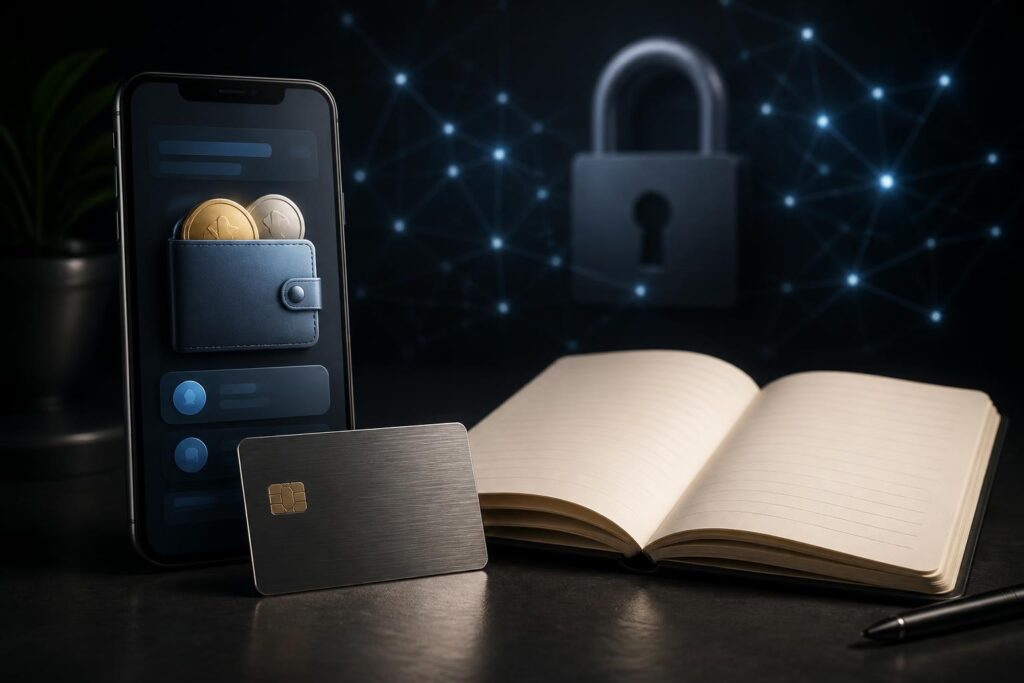
In the crypto ecosystem, the question “who owns the assets?” is not merely related to the name of an account on an exchange. With a self-custody wallet, control over the assets is tied to a private key, while the ability to recover access is usually represented by a phrase made up of multiple words generated when the wallet is set up. This model offers greater autonomy, but at the same time shifts most of the security responsibility from an intermediary organization to the user.
Many people begin to take an interest in self-custody wallets after realizing that assets held on an exchange are not entirely the same as assets controlled through a personal wallet. However, transferring funds to a personal wallet is not an action that guarantees absolute safety. If users store their recovery phrase improperly, send funds to the wrong address, or approve a malicious transaction, autonomy can quickly turn into risk. Understanding how the system works and establishing an appropriate usage process is more important than simply choosing a well-known wallet application.
What Does a Self-Custody Wallet Actually Control?
The blockchain records balances and transaction histories on a distributed network. A wallet does not “contain” crypto in the ordinary sense that a physical wallet contains cash. Instead, it provides tools for creating and managing cryptographic keys so that users can prove their authority to carry out transactions from the corresponding addresses.
A private key is secret information that allows transactions to be signed. Anyone who has the private key, or information that can restore the private key, may be able to control the associated assets, depending on the rules of each network. Therefore, being able to log in to a wallet application is not necessarily the core factor. What matters is whether the user retains the secret information and can recover access.
In some modern types of wallets, users do not directly see a single private key but are given a recovery phrase. This phrase serves as the foundation for generating multiple accounts or addresses. Losing the phrase can make recovery impossible if there is no valid backup option. Conversely, exposing the phrase may allow someone else to restore the wallet on their device without the account owner receiving any reliable warning.
A Recovery Phrase Is Not an Ordinary Password
A password for an online service can usually be reset through email, a phone number, or customer support. A recovery phrase for a self-custody wallet generally does not work that way. The application provider may develop the software, but it does not necessarily hold users’ phrases and cannot arbitrarily restore access.
This is the fundamental difference between a custodial account and a self-custody wallet. When assets are held on a custodial platform, users generally rely on the platform’s login mechanism, identity verification, and support procedures. When assets are held in a self-custody wallet, users must take responsibility for protecting their keys, checking transactions, and preparing a recovery plan. Neither model is automatically suitable for everyone; the choice depends on the user’s level of understanding, transaction needs, and ability to maintain a security process.
A recovery phrase should be treated as the most sensitive information, not as a backup code that can be shared with support staff. Users should not take screenshots of it, save it in email, send it through messaging applications, or enter it into a website simply because the site requests “wallet verification.” Even a legitimate website can be impersonated through advertisements, malicious links, or an interface designed to mimic a familiar application.
Risks That Are Often Underestimated
The first risk is losing the recovery phrase. A record that is misplaced, damaged by water or fire, or stored somewhere no one remembers can prevent the owner from accessing the assets. The second risk is making too many copies of the phrase. Each copy is a potential point of exposure, especially if it is stored on an internet-connected device or in a cloud account.
The next risk comes from confusing addresses and networks. Addresses can be long, difficult to read, and sometimes very similar in appearance. A transaction that has been confirmed generally has no simple mechanism for reversal like a bank transfer order. Therefore, checking the recipient address, asset type, and network before confirmation is mandatory, especially for high-value transactions.
Users also need to distinguish between connecting a wallet to a decentralized application and transferring assets directly. When connecting, an application may request permission to read public information or ask the user to sign a message. When carrying out a transaction, the user may be approving an asset transfer, granting permission to use tokens, or interacting with a smart contract. The content shown in the interface does not always fully explain the technical impact of a signature.
Another danger comes from overly attractive offers. Notifications about receiving rewards, promises to multiply an account, requests to “unlock assets,” or warnings that an account is about to be closed can all be used to pressure users into acting hastily. There is no legitimate reason for a support representative to request a recovery phrase. If an action requires providing this information to someone else, the user should stop and verify the matter through an independent source.
Building a Safer Usage Process
An effective security process begins by identifying the purpose of the wallet. A wallet used to test applications should perhaps be kept separate from a long-term storage wallet. A wallet that frequently connects to multiple services has a different risk surface from one used only to receive and hold assets. Separation helps limit the consequences if an account or application is compromised.
When creating a wallet, users should write down the recovery phrase directly according to the application’s instructions, check the order and spelling, and then store the record somewhere private, durable, and accessible when needed. The phrase should not be stored together with the wallet name, asset addresses, or overly obvious hints in a public place. However, security does not mean hiding the information so thoroughly that even the owner cannot find it again. A good plan must balance protection against unauthorized access with the ability to recover in an emergency.
Before transferring a significant amount of money, users should conduct a test transaction with a small value. This step helps verify the address, network, asset format, and the wallet’s ability to receive funds. After the test transaction is confirmed, users still need to check the address again before the main transaction, because copying from the clipboard or using a device infected with malware can cause discrepancies.
The device used to manage the wallet should also have an up-to-date operating system, a screen lock, and an appropriate authentication method. Users should download applications from official sources, check the publisher’s name, and be wary of applications whose interfaces closely resemble the genuine version. Wallet security cannot be separated from the security of the device, the email account, and the phone number used to receive alerts.
When Should Multisignature Solutions Be Considered?
For high-value personal assets or assets managed jointly by multiple people, relying on a single key can create a serious single point of failure. A multisignature solution requires multiple keys to participate before a transaction is approved. Depending on the configuration, a transaction may require two out of three keys or another number of signatures established in advance.
This model does not eliminate every risk. The parties still have to protect each key, agree on an approval process, and retain configuration information so that the setup can be recovered. If it is configured incorrectly, too many keys are lost, or there are no longer enough authorized people, the assets may become difficult to use. Therefore, multisignature arrangements are more suitable for users with clear governance needs who are willing to maintain a verification process, rather than being viewed as a security button for every situation.
Self-Custody Does Not Mean Doing Everything Hastily on Your Own
The greatest value of a self-custody wallet is autonomy. Users can hold assets without being entirely dependent on the operating hours, withdrawal policies, or status of an intermediary platform. But autonomy only has meaning when accompanied by an understanding of keys, transactions, and the limitations of the tools being used.
New users do not necessarily need to start with large sums or many applications at once. A cautious approach is to learn how to identify addresses, test small transactions, carefully read signing requests, and create a recovery plan before increasing the scale of use. If they do not want to bear full responsibility for safeguarding keys, users can consider a custodial model suited to their circumstances while also understanding the provider’s terms and risks.
A self-custody wallet does not turn crypto into an absolutely safe asset, nor does it make every intermediary unnecessary. It changes where responsibility lies. When moving to this model, users are not merely taking ownership of an application on their phone; they are also taking ownership of a security process that must be maintained over the long term. The recovery phrase must be protected like the key to the assets, transactions must be checked like decisions that are not easily reversible, and every demand to provide secret information should be treated as a warning sign.
