


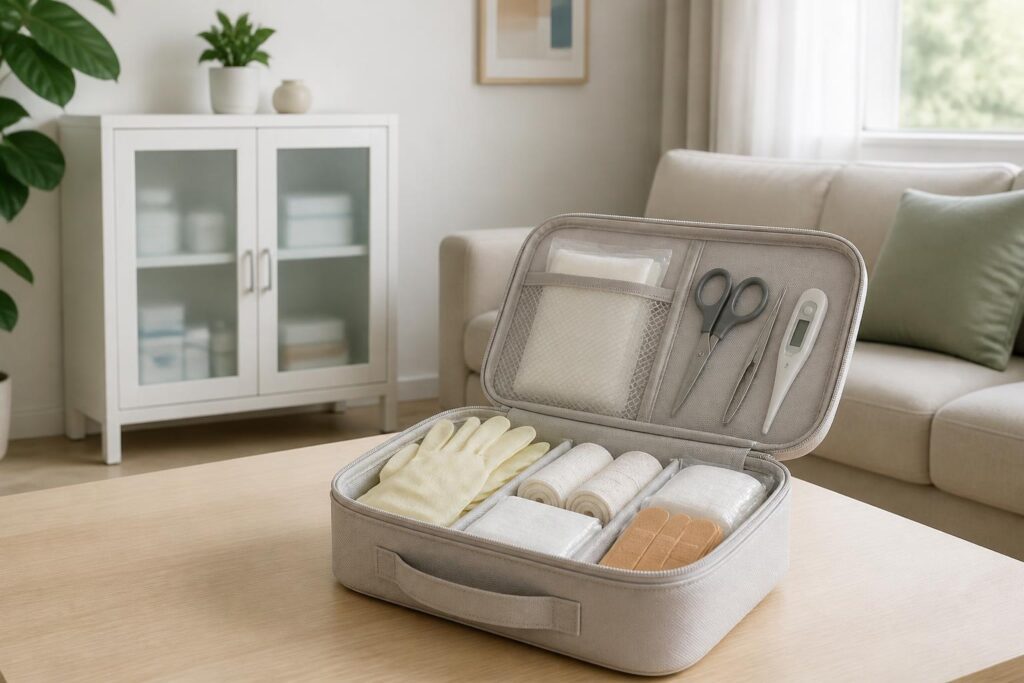
In daily life, minor incidents such as scrapes, cuts, minor burns, insect bites, or sprains can happen at any time. In most cases, they are not too serious, but confusion during the first few minutes often makes treatment less effective and may even worsen the injury. A properly prepared family first-aid kit does not replace a doctor or medical facility, but it can help everyone respond calmly, clean the injured area, and monitor the situation systematically.
What matters is not buying a large number of supplies, but putting together a kit suited to the family’s actual needs, storing it properly, and keeping it in a place everyone knows. The first-aid kit should also be checked regularly to prevent essential supplies from being missing, medicines from expiring, or packaging from being damaged precisely when something is needed.
Identify Your Needs Before Preparing
Every family has different circumstances. Homes with young children often need to focus on scrapes, bumps, and situations that arise during play. Families with older adults may be more concerned about the risk of falls, injuries caused by impacts, or keeping track of medicines being used as prescribed. If the family frequently travels, works in a workshop, cares for pets, or has a kitchen area where high heat is used often, the list of necessary supplies will also differ.
Before shopping, observe the situations that are likely to occur in the living space. Stairways, the kitchen, the bathroom, the balcony, and children’s play areas are places that should be checked first. This helps the family prioritize practical supplies instead of turning the first-aid kit into a container filled with too many items that are rarely used.
Groups of Supplies to Include
A basic first-aid kit should contain supplies for cleaning, covering, and protecting injured areas. Sterile gauze, roller bandages, medical tape, adhesive bandages in various sizes, and a suitable solution for cleaning wounds are commonly useful in ordinary situations. Blunt-ended scissors, clean tweezers, disposable gloves, and small waste bags also make procedures more convenient and limit unnecessary contact with blood or bodily fluids.
A few other supportive items can be added as needed, such as a thermometer, a cold pack to be used according to its instructions, masks, or a small flashlight. If someone in the family needs prescription medication, it should be managed separately according to the instructions of a medical professional rather than placing everything in one shared kit and using it arbitrarily. Over-the-counter medicines should also be kept in their original packaging, together with the instructions and dosage information.
Ointments, oral medicines, or antiseptic solutions should not be chosen solely based on hearsay. A product may be suitable for one person but unsuitable for another because of age, underlying conditions, allergies, or interactions with medicines currently being used. Families with children, older adults, pregnant people, or people with chronic illnesses should seek professional advice when they want to prepare medicines for common situations.
How to Arrange the Kit for Immediate Use
The first-aid kit should be kept in a box or bag that is reasonably moisture-resistant, easy to open, and easy to recognize. It should not be stored in a place that is too high, exposed to high temperatures, near the stove, in a damp bathroom, or behind too many other objects. A good location is one where adults in the family can retrieve it quickly while young children cannot access medicines and sharp objects without supervision.
Inside, supplies should be divided into groups. Gauze, bandages, and covering materials can be placed in one compartment; tools such as scissors, tweezers, and gloves in another; and medicines and products requiring instructions to be read in a separate bag. Frequently used items should be placed on top, while less frequently used supplies can go underneath. This arrangement reduces search time when the person providing assistance is under stress.
A short instruction sheet should be included, listing emergency contact numbers, important allergy information for family members, and any special precautions recommended by medical professionals. This sheet needs to be updated whenever the family’s information changes. However, it should not contain so much content that finding the necessary information becomes difficult.
Principles for Handling Some Common Situations
For a scrape or minor cut, the person providing initial care should first wash their hands, put on gloves if available, and remain calm. The wound should be cleaned gently and then covered with a clean material if necessary. Do not pour multiple chemicals onto the wound without proper guidance, wipe it with an unclean item, or try to remove a foreign object that is deeply embedded. If the wound is bleeding heavily, is in a sensitive location, shows signs of deep injury, or cannot be made to stop bleeding, seek medical help immediately.
For burns, the first priority is to move the burned person safely away from the heat source. The injured area should be cooled properly, while rubbing, breaking blisters, or applying unverified folk remedies should be avoided. Extensive or deep burns, or burns on the face, hands, joints, or airways, need to be assessed by a medical professional. A first-aid kit only supports the initial steps and is not a complete treatment plan.
In the event of a sprain or impact injury, the injured person should limit movement of the painful area and be monitored for unusual changes. If there is severe pain, deformity, rapid swelling, numbness, weakness, or an inability to use the affected body part, do not try to manipulate or realign it at home. Signs related to a head injury, difficulty breathing, loss of consciousness, or rapidly increasing pain should always be treated as serious situations.
In cases of suspected poisoning, a severe allergic reaction, difficulty breathing, seizures, uncontrolled bleeding, or unconsciousness, the family should not try to handle the situation solely with items from the kit. Call emergency services or take the person to a medical facility, depending on the specific situation. When contacting help, provide clear information about what happened, when it occurred, and what the person may have been exposed to or used.
Check and Replace Supplies Regularly
A first-aid kit is valuable only when the items inside are intact and usable. The family should inspect it on a set schedule, such as when cleaning the house or reviewing essential household supplies. Check expiration dates, the condition of the packaging, the cleanliness of the tools, and the amount of remaining supplies. Items that have been opened but are no longer hygienic, or that are damp, torn, or deformed, should be replaced.
Do not remove medicines from their original packaging to save space. Doing so may result in the loss of the product name, expiration date, and usage instructions, while also increasing the risk of confusion. Expired medicines should be disposed of appropriately rather than casually thrown away where children or pets can reach them. If you are unsure how to dispose of medicines, ask a pharmacy or a local medical facility.
After each use, immediately replace any supplies that have run out or become soiled. This is also a good time to review the arrangement: Which items were difficult to find? Which instructions were unclear? Is the kit stored in a convenient location? A brief family discussion about where the first-aid kit is kept and how to call for help may be more useful than buying many additional products when no one knows where they are.
Prepare Well and Use the Kit Within Its Limits
A well-designed first-aid kit helps a family be more prepared for minor incidents, but it does not eliminate the need for prevention. Floors should be kept dry, sharp objects stored safely, chemicals and medicines kept away from children, and equipment that could cause burns used carefully. By reducing the risk of accidents, the first-aid kit can serve its proper supportive role instead of becoming a solution for situations that could have been avoided.
Families also need to remember the limits of self-treatment. If the condition does not improve, unusual signs appear, or the injured person belongs to a group requiring extra caution, seek professional advice. Being well prepared does not mean diagnosing the condition yourself or delaying a visit to a medical facility. The greatest value of a first-aid kit lies in helping everyone carry out the initial steps more cleanly, systematically, and safely while waiting for appropriate assistance.
