


For many years, lithium-ion has been almost synonymous with modern rechargeable batteries. This technology is found in phones, laptops, electric vehicles and many energy storage systems. However, as the demand for transport electrification and renewable electricity storage increases, the technology industry has begun searching for other battery chemistries. Sodium-ion is one of the most notable directions, not because it can immediately replace lithium-ion in every device, but because it offers a different approach to the challenges of raw materials, cost and scale.
Sodium-ion batteries use sodium ions to move between the negative and positive electrodes during charging and discharging. In principle, their operating structure has many similarities to lithium-ion batteries. When the battery is charged, sodium ions move through the electrolyte and are stored in the electrode materials. When the device consumes electricity, the ions return while generating a flow of electrons through the external circuit. This similarity allows researchers and businesses to make use of some of the knowledge, equipment and processes already developed for the lithium-ion battery industry.
Why are sodium-ion batteries attracting attention?
The first reason lies in the raw materials. Sodium is widely available in nature and is often mentioned as being more accessible than lithium. This does not mean that every type of sodium-ion battery is automatically cheaper or free from limitations related to extraction, refining and manufacturing. The final cost still depends on the electrode materials, electrolyte, production lines, safety standards and supply scale. Nevertheless, relying on a common element could help the battery industry build more options instead of depending too heavily on a particular group of raw materials.
Sodium-ion batteries may also reduce pressure on certain minerals that are frequently a concern in battery supply chains. Some designs do not need to use nickel or cobalt in the same roles as many lithium-ion batteries, although the specific composition varies by technology. This is strategically significant: a large-scale energy system will be more sustainable if multiple battery chemistries participate, with each one serving a suitable set of needs.
In addition, sodium-ion batteries have the potential to perform well in applications where size and weight are not decisive factors. When batteries are used to store electricity for buildings, power stations or renewable energy sources, operators are often more concerned with lifetime costs, safety, maintainability and stability than with storing the greatest possible amount of energy in each kilogram of battery. This is an area where sodium-ion may find its own place.
Not a cheaper copy of lithium-ion
The simplest way to view sodium-ion is as a direct alternative to lithium-ion. However, the two technologies have important differences. Sodium ions are larger than lithium ions, so finding electrode materials that can store and transport sodium ions efficiently is a challenge. In terms of weight and volume, many sodium-ion designs generally have lower energy density than competing lithium-ion products. For electric vehicles that need to travel long distances, portable electronic devices or applications with strict weight limitations, this is a significant disadvantage.
Lower energy density does not mean that sodium-ion performs poorly in every situation. A stationary storage system can use more space while still meeting requirements. In that case, reducing raw-material costs or improving supply availability may be more important than making each module smaller. It is also necessary to consider the entire system, including the controller, cooling, protection, replacement and recycling, rather than comparing only one figure for stored energy.
Performance, lifespan and safety also cannot be determined solely from the name sodium-ion. There are many different designs, using different materials and processes. A specific product needs to be evaluated through its actual operating specifications, temperature conditions, number of charge and discharge cycles, charging speed, resistance to damage and the way its battery management system responds to incidents. Belonging to the same technology category does not mean that all products have the same characteristics.
Applications that may be suitable
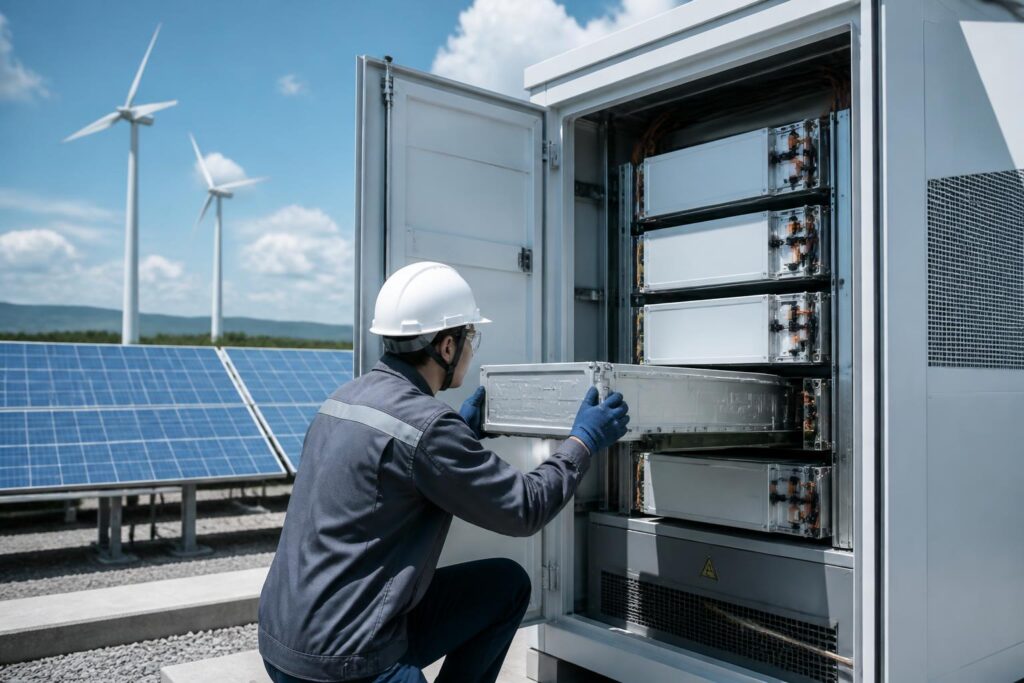
Electricity storage systems are a natural area for sodium-ion technology. Solar and wind power generation varies according to the weather, time of day and operating conditions. Batteries can absorb excess electricity and then supply it back when demand increases or generation declines. For projects of this kind, a larger size may sometimes be acceptable if it helps simplify the supply chain or provides additional cost options.
Power systems in off-grid areas may also consider various types of batteries. Telecommunications stations, independent residential facilities, public works and backup power points all need equipment capable of operating reliably for long periods. However, the choice cannot be based on technology trends. Investors must consider the climate, transportation conditions, repair capabilities, fire prevention standards and plans for handling the batteries after the end of their service lives.
In transportation, sodium-ion may be more suitable for certain short-distance vehicles, urban vehicles or models that place an emphasis on price. This is an area that requires careful evaluation because customers are directly concerned with range, charging time, performance in different weather conditions and durability after many years. If energy density does not yet meet requirements, sodium-ion will struggle to compete in the segment of vehicles requiring very long range. Conversely, in segments where price and supply availability are priorities, this technology may provide an additional option.
The challenges lie in both the laboratory and the factory
Taking a battery chemistry from research to large-scale production is a complex process. Materials must achieve consistent purity, electrodes must be manufactured uniformly, electrolytes must maintain performance under many conditions, and the entire system must undergo safety testing. A single improvement on paper is not enough to create a competitive product. The technology must demonstrate reliability over thousands of cycles, the ability to be mass-produced and a reasonable cost.
The supply chain also needs time to develop. Factories, material suppliers, testing laboratories and recycling companies must coordinate with one another. When production volumes are still small, the advantage of the raw materials may not translate into a low selling price because equipment, research and operating costs remain high. Conversely, if demand grows sufficiently, production scale may help improve efficiency. This is why sodium-ion should not be evaluated based only on a short-term snapshot.
Recycling is an essential part that cannot be overlooked. Used batteries still contain valuable materials and need to be collected, sorted and processed safely. A technology considered sustainable must not only use more widely available raw materials, but also have plans to reduce waste, control fire and explosion risks, and recover materials appropriately. These requirements need to be considered from the product design stage, rather than waiting until the number of end-of-life batteries rises sharply.
Implications for the energy market
The emergence of sodium-ion shows that the future of batteries may not belong to a single technology. Lithium-ion still has major advantages thanks to its manufacturing experience, supply ecosystem and ability to serve a wide range of compact devices. Sodium-ion may complement it in other segments, particularly where lower weight requirements and raw-material supply concerns are given priority. In addition, competition among battery chemistries may encourage manufacturers to improve materials, optimize processes and be more transparent about performance.
For businesses, the important thing is to avoid making choices based on trends. A project needs to clearly define its objectives: how long storage is needed, how power output fluctuates, what the installation space is like, what the ambient temperature will be and how maintenance costs will be calculated. Only then should sodium-ion, lithium-ion or another technology be compared using the same set of criteria. This approach helps link investment decisions to actual needs rather than relying solely on promotional claims.
For consumers, having more choices also brings benefits, but realistic expectations are necessary. Sodium-ion is not an immediate replacement for every type of battery, nor does it eliminate the challenges facing the energy industry. The cost, performance and durability of each product still need to be verified through technical specifications, warranty policies and specific conditions of use.
One piece of the energy transition
Sodium-ion batteries are notable because they raise a broader question about how energy systems should be designed. Rather than seeking one best battery for every application, the technology industry could build a portfolio of solutions in which each chemistry is used where it offers advantages. Sodium-ion has the potential to support electricity storage and certain vehicles, while lithium-ion continues to serve devices that require high energy density.
The path forward still depends on materials research, manufacturing capacity, safety regulations and recycling capabilities. If these bottlenecks can be addressed, sodium-ion could become a significant complementary technology within the battery ecosystem. Its greatest value does not lie in replacing all existing technologies, but in giving the market another option for building power systems that are flexible, diverse and less dependent on a single source of raw materials.
