


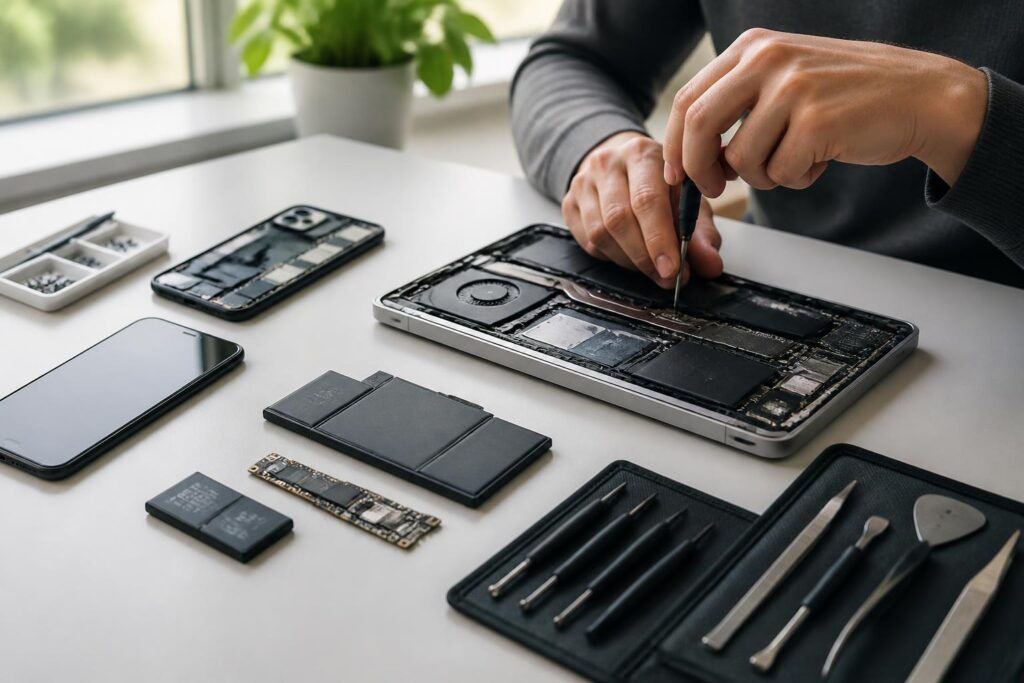
From an Everyday Item to a System That Is Difficult to Intervene In
Phones, laptops, wireless earbuds, smartwatches, and many household appliances are present in most everyday activities. They help people work, study, communicate, entertain themselves, and manage their lives more conveniently. However, when a device develops a fault, users can no longer simply open it up, replace a component, and continue using it as before.
Many products are designed with tightly attached components, difficult-to-remove batteries, hard-to-open casings, or software that limits the ability to replace parts. A minor problem with a charging port, screen, keyboard, or battery can result in the entire device being classified as needing replacement. This issue raises an increasingly important question: do buyers truly possess the full ability to use and repair the item they have paid for?
This is the foundation of the concept of the right to repair. This concept is not only about allowing users to take a device to any repair shop. It also concerns product design, access to parts, technical documentation, diagnostic tools, software updates, and how manufacturers support devices after they are sold.
What Does the Right to Repair Include?
At a basic level, the right to repair means that users or independent repair providers have a reasonable opportunity to restore a device to working order. That opportunity requires several accompanying conditions. Products need to have structures that can be disassembled and reassembled, replacement parts need to be available for a suitable period, and technical information should not be completely locked within the manufacturer’s system.
The right to repair can also be viewed from three perspectives. The first is the right to physical access, such as being able to open a device without damaging important components. The second is the right to access information, including repair instructions, error codes, and testing procedures. The third is the right to software access, because some devices may accept new components but still fail to operate fully if the system does not allow those components to be recognized or calibrated.
These factors do not mean that every user must repair electronic devices themselves. Most users will still need technicians when a job requires specialized tools or could affect safety. What matters is that they have the right to choose where repairs are carried out and are not forced to discard a device simply because the necessary parts, documentation, or access rights are unavailable.
Why Is Repairability Important?
The most apparent benefit is extending a product’s life cycle. Repairing a device instead of replacing it allows users to postpone a major expense and make better use of the money they have already spent. For organizations, schools, small businesses, or families with many devices, repairability also makes budget planning more proactive.
Repairability also changes how users assess the quality of technology. A good product is not measured only by processing speed, screen brightness, or the number of features. Durability, battery replaceability, ease of disassembly, and the length of support are also important criteria. If two devices offer similar performance but one can have its components replaced more easily, that choice may provide greater long-term value.
From an environmental perspective, extending the period of use helps reduce the need to manufacture new devices and decreases the amount of discarded products. Every electronic device is a combination of many materials, components, and manufacturing processes. When a small part fails but the entire product is discarded, the rest of the device is not being used to its full potential. Repair does not solve the entire electronic-waste problem, but it can slow the short-term cycle of consumption.
The right to repair also creates a more diverse service market. Independent shops, local technicians, and businesses specializing in maintenance can provide options suited to different groups of users. This competition can encourage more transparent services, helping customers compare costs, time, and quality instead of relying solely on a single channel.
Common Barriers
The first barrier lies in product design. A thin and compact device may offer an appealing user experience, but optimizing its size can sometimes mean that components are permanently adhered or integrated into an assembly that is difficult to replace. Water- and dust-resistant designs can also make the process of opening and resealing a device more complicated. Not every design decision is intended to restrict repairs, but users need to understand these trade-offs before making a purchase.
The second barrier is parts availability. If a manufacturer supplies components for only a short period, or if the price of a part is too high compared with the device’s remaining value, repair becomes less appealing. Non-genuine parts can also raise concerns about compatibility and safety. In this situation, users face a difficult choice between lower costs and the risk of unstable operation.
The third barrier comes from software. Some devices need to be calibrated after a component is replaced. If calibration tools are available only to authorized service centers, independent technicians may encounter difficulties even after replacing the correct part. In addition, older devices may lose software support before their hardware has genuinely reached the end of its functional life. In that case, a product’s actual life span is determined not only by its physical durability but also by its update policy.
Finally, there is the issue of information. Buyers often find it difficult to know which devices are easy to repair, which components can be replaced, and what maintenance costs may be over the following few years. Sales specifications typically focus on new features, while information about serviceability receives less attention. This means that the initial purchasing decision does not fully reflect the long-term cost of ownership.
What Can Users Do?
Before buying, users should consider repairability as part of their selection criteria instead of focusing only on specifications. They can find out whether the battery is replaceable, whether the memory can be upgraded, and whether the screen and charging port are separate components or integrated with the mainboard. These questions are especially useful for high-value products or those expected to be used for many years.
Users should also keep receipts, warranty information, and repair histories. These records help establish the device’s condition, support discussions with technicians, and prevent unnecessary component replacements. When taking a device in for repair, users should request a clear description of the fault, the proposed solution, the components to be replaced, and the warranty terms after the repair.
Not every fault should be fixed by the user. A swollen battery, signs of unusual heat, a burning smell, or damage related to the power supply requires careful handling. Attempting to open a device without the appropriate tools and knowledge can increase the risks. The right to repair does not turn everyone into a technician; it gives users more choices and information when they need assistance.
For software-related problems, users can begin by backing up their data, updating the system according to official instructions, and checking the relevant settings. However, resetting the device or modifying its software also requires consideration, as it may cause data loss or affect the warranty. Responsible repair habits should always go hand in hand with habits that protect personal data.
How Should Manufacturers and the Market Change?
Designing products for repair does not necessarily mean sacrificing slimness, aesthetics, or durability altogether. Manufacturers can consider more modular structures, use assembly methods that facilitate maintenance, and provide parts for a reasonable period. Clear instructions can also help reduce errors caused by improper disassembly and reassembly and create conditions for repair providers to operate professionally.
Transparency is another important factor. Buyers should know the expected period of software support, the replaceability of major components, and the limitations that may apply after a repair. If a component cannot be replaced separately and the entire assembly must be replaced, that information should be presented clearly. When data is fully disclosed, consumers can compare products based on their total cost of use rather than looking only at the initial purchase price.
The market also needs to distinguish between safe repairs and poorly controlled repairs. Expanding the right to repair should go hand in hand with requirements concerning parts quality, data protection, battery handling, and electrical safety. A strong repair ecosystem is not merely one with many places that accept repairs; it also has transparent procedures, clear responsibilities, and the ability to provide service warranties.
Choosing Technology with a Longer-Term Perspective
The right to repair offers a different way of viewing the relationship between people and their devices. Users are not merely buyers of new products in successive cycles; they are also managers of their own technology assets. Manufacturers are not competing only through the features they launch this year; they also need to demonstrate that their products can provide reliable service in the years that follow.
Not every device can be repaired indefinitely, and not every repair is financially worthwhile. Even so, the right to know, to choose, and to access a reasonable repair option has value in its own right. It helps users avoid making hasty replacement decisions, encourages more sustainable design, and creates opportunities for local technical services.
When considering a technology product, the important question is not only what the device can do today. It is also necessary to ask how it will be maintained, how its components can be replaced, and whether users will still have control when the product develops a fault. A market that values repairability will steer technology toward greater durability, economy, and suitability for real-world use.
