

Blockchain is often described as a system capable of recording and verifying data without the need for a single intermediary. However, a blockchain network does not inherently know the price of an asset, the result of a match, the status of a delivery, or an event that has just occurred in the real world. It can only process data that already exists within the network itself. The gap between on-chain data and the outside world therefore becomes an important issue for many decentralized applications.
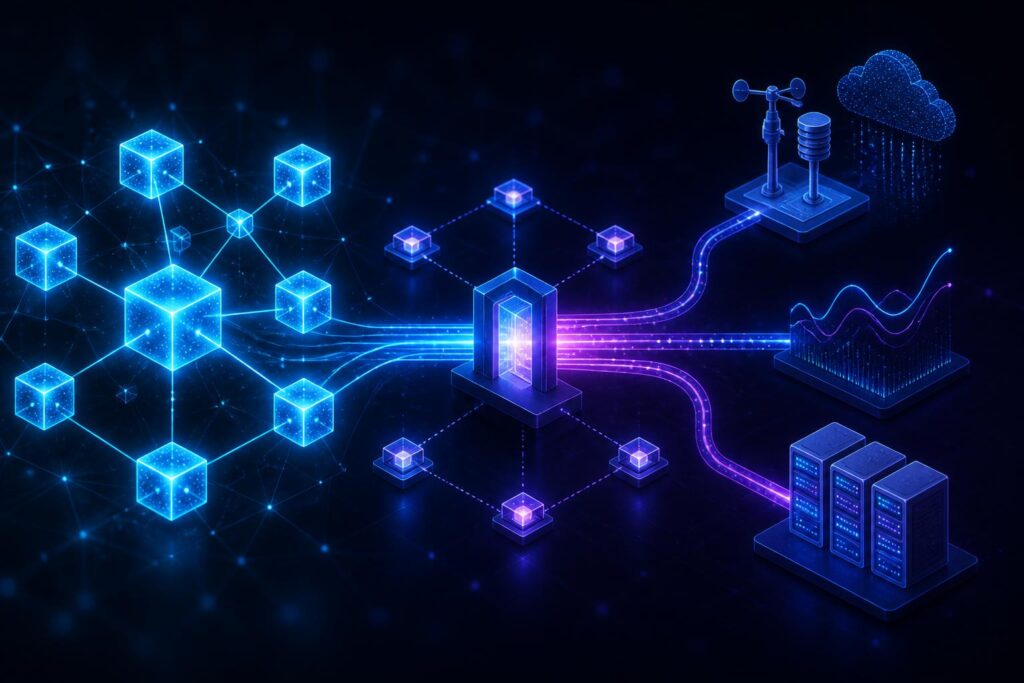
Blockchain oracles were developed to address this gap. An oracle can be understood as an intermediary layer that supplies off-chain data to smart contracts. With an oracle, a program on a blockchain can make decisions based on information that the network itself cannot observe. Even so, an oracle is not simply a data transmission channel. The quality, origin, aggregation method, and resistance to manipulation of the data can all directly affect an application’s security.
How Do Blockchain Oracles Work?
Smart contracts typically execute according to preprogrammed conditions. If all the necessary data is located on the blockchain, the contract can read that data and process it directly. But when a condition depends on an external source, the application needs a mechanism for bringing that information into the network.
A common process consists of several steps. First, the application or smart contract determines the type of data it needs to use, such as the reference price of an asset or the result of an event. Then, one or more oracle providers collect information from external sources. The data may be processed, verified, and aggregated before being sent to the blockchain. Once the data is on-chain, the smart contract can read it and carry out the corresponding action.
It is important to note that an oracle does not automatically make real-world data absolutely accurate. It only creates a mechanism for transmitting data into the blockchain environment. If the original data source is incorrect, disrupted, or manipulated, the result submitted on-chain may still be wrong. Therefore, oracle design must take into account the data sources, the number of providers, the verification method, and how the application responds when the data is abnormal.
Why Does Blockchain Need Oracles?
Blockchain has an advantage in recording transactions and states that already exist on the network. Smart contracts can check balances, token ownership, interaction history, or conditions written into the code. However, blockchain cannot independently verify every event outside the network. Without oracles, many application ideas would be limited to internal data.
In decentralized finance, price data is an obvious example. A lending protocol may need to know the relative value of collateral in order to assess the safety of a loan. A derivatives application may need a reference price to determine the settlement result. If price data arrives late, lacks liquidity, or is controlled by a single source, both users and protocols may face risks.
Beyond finance, oracles can also support insurance, gaming, supply-chain, and governance applications. A parametric insurance contract may need data about a weather phenomenon or a predetermined event. A game may need an unpredictable source of randomness to distribute outcomes. A supply-chain system may reference information from sensors or inventory-management software. In each case, the oracle serves as a connector, but it cannot replace the entire process of verifying events in the real world.
Common Oracle Models
Oracles can be classified in several ways, depending on the direction of data transmission and the degree of system decentralization. Inbound oracles bring data from outside onto the blockchain. Outbound oracles transmit information from the blockchain to an external system, such as sending a request to carry out an action after a contract reaches a specified condition. Some oracles also provide data directly on request, while others update data periodically or when a significant change occurs.
In terms of data sources, an oracle may rely on a single source or combine multiple sources. A single-source model is usually easier to deploy, has lower operating costs, and may be suitable for less sensitive use cases. However, it creates a centralized point of dependence. If that source fails, goes offline, or deliberately provides false information, the application using the data may be affected.
A multi-source model attempts to reduce dependence on one party. Multiple providers can submit data, after which the system applies an aggregation method such as taking the median value or removing results that differ excessively. This approach does not guarantee the elimination of all errors, but it can make manipulation more difficult. In return, the system is usually more complex and requires incentive mechanisms, monitoring, and procedures for handling cases in which the sources disagree.
Where Do the Risks Lie?
The greatest risk of an oracle is the “garbage in, garbage out” problem. Blockchain can ensure that once data has been recorded, it is difficult to alter through ordinary means, but that does not prove the original data was accurate. If an oracle puts incorrect information on-chain, the immutability of blockchain can cause that mistake to be executed consistently and make it more difficult to reverse.
The second risk is the possibility of data manipulation. An attacker may try to interfere with a data provider, cause price fluctuations in a market with low liquidity, or exploit a delayed update. In financial applications, even a brief discrepancy can affect asset valuation, liquidations, or reward distribution.
The next risk concerns latency. Off-chain data may change faster than an oracle can update it. When a contract uses an outdated value, the resulting decision may no longer correspond to actual conditions. Conversely, updating too frequently can increase costs and place additional pressure on the system.
There are also operational and governance risks. Oracle providers may experience technical failures, lose connectivity, or change their policies. The system must also determine who has the authority to change data sources, update software, or handle emergencies. If these powers are concentrated in a small group, the application may be far more centralized than it initially appears.
How Should Users Evaluate Oracles?
When examining an application that uses an oracle, users should not look only at the interface or descriptions of its decentralization. They should find out where the data comes from, how many sources provide it, what aggregation method is used, and how frequently the data is updated. A transparent protocol should disclose basic information about its oracle architecture so that the community can evaluate it.
It is also necessary to consider how the system responds when data is interrupted or shows signs of abnormality. Does the application pause temporarily, use the last known value, or switch to an emergency procedure? Who has the authority to intervene, and are those actions publicly recorded? These are practical questions, because no data system can completely eliminate failures.
For ordinary users, an important principle is not to regard an oracle as absolute proof. Data displayed on a blockchain may be transparent in terms of its update history, but its accuracy still depends on the data supply chain upstream. When an application involves assets or financial obligations, understanding the oracle mechanism is no less important than understanding transaction fees or the conditions of the smart contract.
Oracles and the Limits of Decentralization
Oracles reveal an important reality: the decentralization of blockchain cannot automatically extend to all real-world data. A network may be decentralized in its transaction validation while still depending on a centralized information source. Therefore, evaluating an application requires distinguishing between the decentralization of the underlying blockchain, the smart contract, and the external data layer.
This does not mean that oracles are a weakness that diminishes blockchain’s value. Rather, an oracle is an infrastructure layer that must be designed to suit the risk level of each application. An experimental game may accept a simpler approach than a system used to manage substantial assets. Safety standards, costs, and speed may also vary depending on the use case.
In the future, oracle systems may continue combining multiple data sources, cryptographic verification mechanisms, hardware, provider networks, and more transparent governance processes. Regardless of the technology used, the core objective remains to create a data channel that can be verified, withstand failures, and meet the requirements of smart contracts.
Conclusion
Blockchain oracles are components that enable on-chain applications to interact with the outside world. They expand the capabilities of smart contracts from processing internal data to responding to real-world conditions, but they also introduce a new set of risks into the system. Data sources, latency, resistance to manipulation, and incident-response mechanisms all need to be carefully considered.
Understanding oracles gives users a more realistic view of blockchain. An application should not be evaluated solely by whether its data is on-chain, but also by how that data is created, verified, and updated. When this connecting layer is designed transparently and appropriately, blockchain has greater opportunities to address problems beyond the scope of purely digital transactions.
