


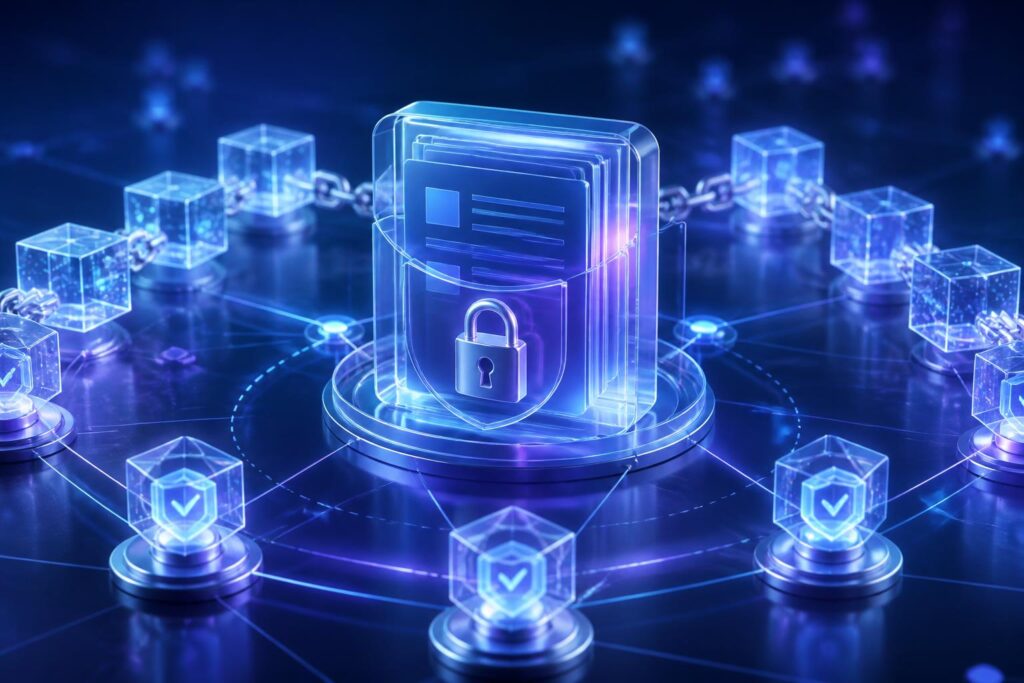
In many discussions about blockchain, the words “immutable” and “transparent” often appear together. This description helps newcomers understand the technology’s advantages, but it can also create overly simplistic expectations. Data recorded on a blockchain is not like a file that can be freely opened, edited, or deleted on a personal computer. However, that does not mean all data is absolutely immutable, nor does it mean that observers can know the real identity behind every transaction.
To use blockchain responsibly, three different questions need to be separated. Can the data be changed after it is recorded? Who can read that data? And if the data contains errors or sensitive information, does the system have any way to deal with the consequences? The answer depends on the type of blockchain, how the network is governed, what kind of data is put on-chain, and the design of the application connected to it.
What Does Immutability on the Blockchain Mean?
At a basic level, a blockchain is a chain of data blocks linked to one another through cryptographic mechanisms. Each block usually contains a list of transactions or other records, along with information that links it to the previous block. Once a transaction has been accepted by the network and added to the shared history, secretly changing its old content becomes difficult because the change could break the links with subsequent blocks.
On public networks, validators typically maintain copies of the ledger and check transactions according to shared rules. A record is considered valid only when it meets those rules, such as a signature matching the key controlling the assets or a transaction not spending the same unit of an asset twice. This mechanism enables independent verification: users do not necessarily have to trust a single authority to know how the history was recorded.
However, “immutable” should be understood as meaning difficult to change as long as the network continues to follow its consensus mechanism and current rules. It is not a promise that no scenario could cause the history to be reorganized, the network’s rules to change, or incorrectly submitted data to be validated. On some blockchains, transactions are highly stable after confirmation. On other networks, particularly those with a more centralized governance structure, the authority to intervene or change the state may be distributed differently.
Not All Data Is Stored Directly on the Chain
A common misconception is that all information related to a blockchain application is placed in its entirety on the ledger. In practice, data can be stored in many ways. A transaction may record only the asset amount, the sender’s address, the recipient’s address, and certain technical parameters. Image files, long texts, or identification documents are often stored in another system, while the blockchain retains only a representative code, a link, or proof that the data existed in a particular state.
Recording a representative code, often generated from data through a hash function, can help verify the data later. If the content is changed, the regenerated representative code may no longer match. But this mechanism does not by itself guarantee that the original file will always exist, nor does it prove that the original content was accurate or lawful. A blockchain can confirm that a record was associated with a particular time or transaction, but it cannot by itself confirm every claim contained in that record.
This is an important distinction between data integrity and data correctness. False information can still be recorded very persistently. If users upload the wrong document, an incorrect address, or personal data to a system that is difficult to modify, the technology cannot automatically turn that information into something accurate. Therefore, checking data before recording it is often no less important than protecting it afterward.
Transparency Does Not Mean Public Disclosure of Identity
Public blockchains generally allow anyone to inspect transaction histories through suitable data-reading tools. However, what is displayed is usually an address or technical identifier, not the user’s real name and personal details. This creates a situation in which transactions can be observed without necessarily knowing exactly who is behind them.
Even so, a blockchain address should not be regarded as absolutely anonymous. An address can be linked to a real identity when the user makes it public, uses it with a service that requires verification, or leaves sufficiently clear traces across multiple transactions. Once that connection is established, the history associated with the address may provide extensive information about asset flows, activity times, and relationships with other addresses.
Privacy risks also depend on how an application builds its interface and how off-chain data is combined. An application may display an account name, profile information, or interaction history alongside a technical address. Although that information may not all be stored on the blockchain, it can still significantly reduce the user’s level of privacy. Therefore, ledger transparency and identity protection are two separate problems that must be designed separately; they cannot be solved with a single slogan.
Why Should Sensitive Data Not Be Put Directly on the Blockchain?
Blockchain is suitable for records that need to be checked by multiple parties and for which there is a reason to maintain a long-term history. But its resistance to modification becomes a problem when the data contains personal information, health records, internal documents, access keys, or content that users may later want to withdraw. Once data has been distributed to multiple network nodes, requiring every copy to disappear can be very difficult, or even impossible under the network’s design.
Encryption can reduce the risk of outsiders reading the content, but it should not be considered a permanent solution for every type of data. If the decryption key is exposed or lost, or if the encryption method becomes unsuitable, the recorded data can still become a burden. Moreover, sensitive information does not always need to be fully readable to create a risk. The relationships among the timing, addresses, values, and frequency of transactions can also reveal behavior or connections between parties.
A more cautious approach is to put only the minimum necessary information on-chain. The original data can be kept in a system with appropriate access controls, while the blockchain stores proof, a reference code, or a status that needs to be confirmed by multiple parties. This design does not eliminate every risk, but it helps reduce the consequences if off-chain data needs to be edited, access needs to be restricted, or the data must be handled in accordance with legal requirements.
What Happens When Data Is Recorded Incorrectly?
In a traditional database system, an administrator can correct a record, create a new version, or mark old data as no longer valid. On a blockchain, the handling is usually different. The old transaction may remain, while the application records a new transaction to show that the previous state has been adjusted, canceled, or replaced. The history is not deleted; instead, additional context is added.
This approach lets observers see the process of change, but it is not always convenient. If the interface displays only the new status without explaining the old record, users may misunderstand. If the application has no update mechanism, a data error can affect many subsequent operations. For digital assets, sending funds by mistake to an address that is not under one’s control is generally not like a data-entry error for which one can call a bank and request a reversal.
Therefore, error correction should be considered from the design stage. An application may need a multistep confirmation process, limits on administrative authority, a waiting period before important actions, or a mechanism for issuing corrective records. These measures do not turn blockchain into a database that can be freely edited; instead, they create a more transparent way to record changes when errors occur in practice.
What Should Users Check Before Recording Data?
First, determine which data truly needs to be on the blockchain. If the goal is merely to prove that a document existed or has not been altered, consider recording representative proof rather than the entire content. If an application requires personal data to be linked to an address, users should clearly understand who can read it, where the data is stored, and for how long.
Next, check the recipient address, the network being used, the type of asset, and the confirmation details before signing. A wallet or application interface may display abbreviated information, while the actual action contains more parameters. Do not sign a request simply because it appears in a familiar window. Consider what permissions the application is requesting, whether those permissions have an expiration, and to what extent they can be limited.
Finally, distinguish between data that can be verified and data that needs to be kept confidential. A public record may make reconciliation convenient, but that convenience comes with a lasting trail. When it is unclear whether information is sensitive, the safer choice is generally not to put the original data on-chain and to learn more about the application’s storage design.
Balancing Verifiability and Control
The value of blockchain does not lie in putting as much data on-chain as possible. Its value comes from the ability to create a history that multiple parties can verify according to the same set of rules, in situations where sharing the authority to record information is necessary. The durability of that history can support reconciliation, reduce disputes, or prove the sequence of events, but it must be accompanied by an appropriate governance model and data protection.
In practice, the best solution is often a combination of on-chain data, off-chain systems, access controls, and error-handling procedures. Blockchain can serve as a verification layer, while other systems handle detailed storage, authorization, and information updates. No architecture is suitable for every application; the right choice depends on the sensitivity of the data, the number of participating parties, and audit requirements.
Understanding immutability correctly helps users avoid two extremes: believing that blockchain solves every problem of trust, or assuming that all data on it can never be used safely. Data recorded on-chain may be difficult to change, but it still needs to be checked before recording; it may be transparent, but it is not automatically private; it may be verifiable, but it does not prove the correctness of the content by itself. When these three limitations are incorporated into the design and use process, blockchain can be used as a purpose-built verification tool rather than as a place to store everything.
