


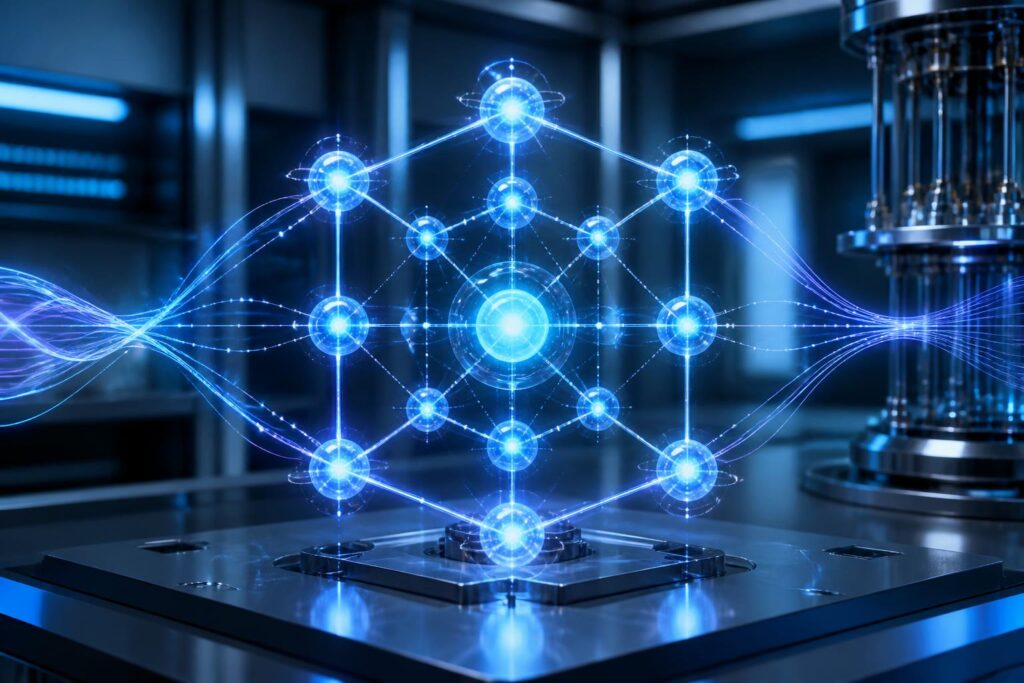
In discussions about quantum computers, the number of qubits is often mentioned as an important measure. However, a system with many physical qubits is not necessarily closer to a useful quantum computer. The greater challenge lies in keeping quantum information intact for long enough and performing calculations accurately enough. This is why quantum error correction, particularly the construction of logical qubits, is considered one of the foundations determining the future of the field.
Qubits are highly sensitive to their surroundings. Heat, vibrations, electromagnetic noise, imperfections in control pulses, or unintended interactions between components can all alter their states. In classical computers, a bit has only two states, and errors can often be detected, copied, or corrected through relatively direct methods. With qubits, it is impossible to copy an arbitrary quantum state exactly. The system therefore has to find a way to protect information by distributing it across multiple qubits, while measuring signs of errors without destroying the information needed for computation.
From Physical Qubits to Logical Qubits
A physical qubit is the actual quantum element created and controlled in hardware. Depending on the technology, it may be formed from superconducting circuits, trapped ions, neutral atoms, photons, or other platforms. Although their implementations differ, all physical qubits are affected by noise and have some probability of experiencing errors during storage, control, or measurement.
A logical qubit is an abstraction created from multiple physical qubits. The information in a logical qubit is not contained entirely in any one physical qubit; instead, it is encoded in a distributed manner. The system continuously checks characteristics known as error syndromes to determine whether a fault has occurred. This checking is not intended to read the value of the logical qubit directly, because doing so could destroy the computation. Instead, the controller looks for indirect signs indicating the type of error or its approximate location, and then applies an appropriate correction operation.
This approach creates a significant trade-off. A logical qubit requires many physical qubits, along with additional control, measurement, connectivity, and decoding circuits and software. Consequently, the number of logical qubits is always much smaller than the total number of physical qubits in a real system. When we say that a quantum computer can perform long and complex calculations, the important question is not only how many qubits the machine has, but also how many of them can operate as reliable logical qubits.
Why Are Quantum Errors Difficult to Handle?
Errors in quantum computers are not limited to a qubit switching from one state to another. A quantum state can also lose coherence, causing the phase relationship between components of the state to deteriorate. Two commonly discussed groups of errors are errors that change the value in a way similar to a bit flip and errors that change the phase. In practice, these errors can occur simultaneously, be related to one another, and arise from many different sources.
The sensitivity of qubits means that every layer of the system must be optimized. The hardware needs to create a stable environment, control pulses must have precise shapes and timing, the measurement system must be fast enough without introducing additional noise, and the software must determine how to interpret syndrome data. A single underperforming component can reduce the effectiveness of the entire error-correction code.
Unlike classical memory, quantum information cannot be protected by creating multiple independent copies and then selecting the correct one. Quantum error-correction codes must encode information in a special structure that allows errors to be detected through ancillary measurements. This is one reason quantum error correction requires the combination of physics, mathematics, control engineering, chip design, and computer science.
The Threshold Principle and the Race to Reduce Errors
An important idea in quantum error correction is the threshold principle. In general terms, if the error rate of basic operations is below a certain level and the system is designed appropriately, increasing the scale of the error-correction code can reduce the effective error rate of logical qubits. This opens up the possibility of performing calculations much longer than the natural lifetime of a physical qubit.
However, the threshold principle is not a promise that simply adding more qubits will make every problem disappear. The threshold depends on the error model, the type of code, how the qubits are connected, the quality of measurements, and many other technical conditions. If the hardware continues to have error rates above the required level, scaling up the system may increase costs without producing better logical qubits. Even after the threshold has been surpassed, the benefits generally arrive incrementally and require substantial resources.
That is why research groups are not only seeking to create more qubits but also to reduce errors in each operation. A small system with stable gates, measurements, and connections may be more valuable than a large system that is difficult to control. At the current stage, progress is often assessed through the ability to create, protect, and operate logical qubits, rather than relying solely on the nominal scale of the hardware.
How Do Logical Qubits Change Quantum Computer Architecture?
As logical qubits become more reliable units of computation, the architecture of quantum computers must also change. The processor needs not only physical qubits but also a network of connections, a control layer, and a decoding system operating almost in real time. Each error-correction cycle produces ancillary data, and this data must be processed quickly enough to prevent the system from slowing down or accumulating errors before a correction decision is made.
The costs in energy, space, and complexity also increase. Some platforms require deep-cooling systems, while others require optical equipment, vacuum systems, or precise laser control. The control electronics may have to operate under special conditions and be designed to limit noise reaching the quantum elements. Therefore, quantum error correction is not merely an algorithm running on top of the hardware; it is a principle that governs the machine’s entire design.
At the software level, future algorithms will also have to account for the costs of encoding and error correction. A theoretical operation may require a large number of operations when implemented on logical qubits. Techniques for circuit optimization, measurement scheduling, and resource allocation will play an important role in turning mathematical ideas into programs that can actually run.
Implications for Commercialization
Quantum error correction helps clarify the gap between a technical demonstration and a practical application. A device may demonstrate the ability to control many qubits or complete a specialized task, but that does not mean it can perform useful calculations over long periods. Applications requiring many successive layers of operations will need stable quantum states, the ability to recover when errors occur, and repeatable results.
In fields such as materials simulation, computational chemistry, optimization, or cryptography, the value of a quantum computer depends on the quality of its results, not merely on demonstration speed. If the error rate causes results to vary too much between runs, users will find it difficult to incorporate the system into research or production workflows. Logical qubits may not solve the entire problem, but they provide a foundation for controlling reliability in a more systematic way.
This also affects how businesses and investors evaluate announcements in the industry. Metrics such as qubit count, coherence time, or the accuracy of an individual gate remain meaningful, but they need to be considered alongside the ability to create logical qubits, the error rate after decoding, and the scalability of the architecture. A convincing roadmap must explain how to move from physical qubits to usable logical computing blocks capable of running large programs.
The Road Ahead Still Has Many Layers of Challenges
No single error-correction code is suitable for every type of hardware. Each code has its own requirements for qubit usage, connectivity, and measurement costs. Some methods prioritize the ability to operate on locally connected networks, while others may take advantage of specialized hardware structures. The choice will depend on qubit quality, control capabilities, and the system’s objectives.
In addition, error correction cannot replace hardware improvements. If physical qubits are too unstable, the encoding layer will have to use more resources to achieve the same level of reliability. Conversely, better hardware reduces the cost of creating logical qubits and expands the space available for applications. Genuine progress therefore needs to occur simultaneously in materials, devices, architecture, software, and measurement methods.
For the public, the concept of a logical qubit may sound more abstract than familiar images of quantum processors. Yet this is precisely the foundational layer that determines whether quantum computers can move beyond the experimental stage and become reliable computing tools. The number of qubits still matters, but quality, durability, and error-correction capabilities are what reveal how much useful work a system can perform.
Conclusion
Quantum computing is not merely a matter of creating quantum states; it is also a matter of protecting those states throughout the computation. Quantum error correction and logical qubits provide an approach to dealing with the inherent fragility of quantum hardware. This path requires many physical qubits, complex control systems, and continuous advances in the design of error-correction codes.
In the years ahead, the noteworthy question will not only be who possesses the largest quantum computer, but who can transform imperfect physical qubits into stable, scalable logical qubits capable of supporting meaningful calculations. When that capability is demonstrated consistently, quantum computers will truly be closer to taking on the role of a new technological platform.
