


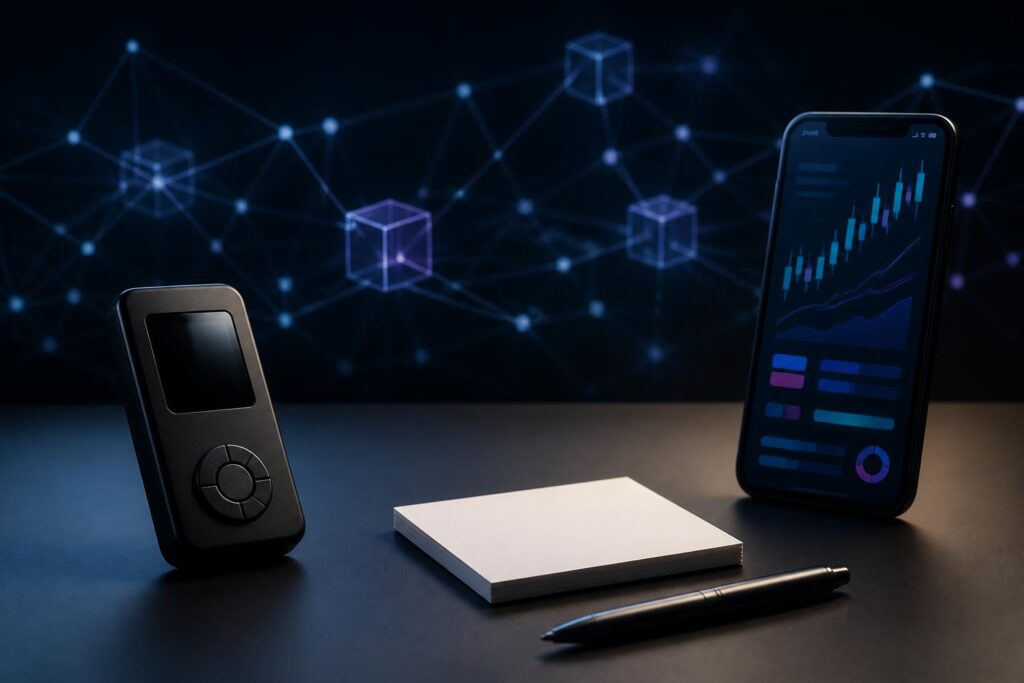
In the world of cryptocurrency, the phrase “not your keys, not your assets” is often mentioned when discussing self-custody. The idea is fairly easy to understand: if digital assets are held in an exchange account, users generally do not directly control the private keys used to sign transactions. By contrast, when using a personal wallet, access to the assets is tied to a set of keys managed by the users themselves.
However, transferring assets from an exchange to a personal wallet does not automatically make everything safe. Self-custody comes with greater responsibility. Users must protect their recovery phrase, check the receiving address, update their backup procedures and recognize different forms of fraud. Among the tools chosen for this purpose, cold wallets are often considered a suitable option for people who want to reduce their private keys’ exposure to online environments.
What Is a Cold Wallet?
Cold wallet is a general term for a method of storing private keys in an environment that is not regularly connected to the internet. Hardware wallets are a common example, but the concept of a cold wallet is not limited to one specific type of product. The key point is that the private keys are created and protected in an isolated environment, rather than always being present on a computer or phone that is connected to the internet.
Cold wallets should be distinguished from exchange accounts. When holding assets on an exchange, users log in with an account and place orders through the platform’s system. When using a personal wallet, the assets are still recorded on the blockchain, while the wallet holds the information needed to prove control and sign transactions. In other words, a wallet does not physically “contain” cryptocurrency; it helps users manage keys and interact with the network.
Hot wallets, by contrast, are wallets that are connected to the internet more frequently, such as applications on phones, browser extensions or software on computers. Hot wallets are convenient for small transactions, everyday activities and interacting with decentralized applications. Cold wallets generally prioritize key isolation, making them more suitable for long-term holdings or assets that do not need to be moved constantly.
Why Can Cold Wallets Increase Security?
A major risk to private keys usually arises when the keys or recovery information are exposed. An online device may be affected by malware, fake browser extensions, phishing websites or careless user actions. If an attacker obtains enough information to sign a transaction, the blockchain generally has no central mechanism for reversing a transaction that has already been confirmed.
Cold wallets create an additional layer of separation between private keys and the online environment. In a typical process, users can view transaction information on a computer or phone, while signing is performed on a dedicated device. This design does not eliminate all risks, but it makes stealing keys through a conventional online attack more difficult.
The value of a cold wallet therefore lies not only in its hardware. It also lies in the way it is used. A good device that is set up using an untrustworthy source, a recovery phrase that has been photographed, or a transaction that is confirmed without carefully checking the address can still result in asset loss. Security is a combination of tools, habits and the ability to control information.
The Recovery Phrase Is the Most Important Point
When setting up a wallet, users are usually provided with a recovery phrase. This is information that can be used to restore access to the wallet on a compatible device. Therefore, this phrase must be treated as a master key, not as an ordinary password that can be sent to support staff for a reset.
The recovery phrase should not be stored in screenshots, email, cloud-synchronized note-taking applications or online chats. These locations may be accessed if an account is taken over or a device is infected with malware. Offline storage on durable material, kept in a private and controlled location, is generally more suitable for long-term protection.
Users should also not enter their recovery phrase into a website, form or application simply because someone claiming to be a support representative requests it. There is no legitimate reason to share this information with anyone else in order to “unlock,” “verify” or “claim a reward.” Anyone who obtains the recovery phrase may try to control the associated assets, regardless of where they are located.
Backups also need to be considered carefully. A single copy can be lost through fire, water, theft or misplacement. Multiple copies, however, increase the risk of someone else seeing them. Users should determine a balance between recoverability and privacy, while avoiding keeping all copies in the same location or exposing them to the same risk.
Common Mistakes When Using Cold Wallets
The first mistake is buying a device from an unclear source or receiving a second-hand device without checking the setup process. Hardware devices should be configured according to the manufacturer’s official instructions, with the recovery phrase generated during that process itself. If a product package already includes a recovery phrase and instructs the user to use it immediately, that is a sign to stop and investigate.
The second mistake is confusing the device unlock code with the recovery phrase. An unlock code may help prevent someone else from using the device in certain situations, but it does not replace the recovery phrase. Losing the unlock code can be inconvenient; exposing the recovery phrase can directly threaten the entire wallet.
The third mistake is confirming transactions too quickly. Scammers may send a fraudulent link or trick users into connecting their wallets to an untrustworthy application. Signing a transaction does not always mean that funds will be transferred immediately, but it may grant permissions or perform an action that the user does not fully understand. Before signing, users need to carefully review the network, address, asset, amount and type of permission being granted.
The fourth mistake is testing with all of one’s assets from the outset. With a new address, users should begin with a small amount to check the network, receiving address and recovery capability. Once the test transaction has been confirmed and the process is working correctly, they can consider transferring the remainder. Network fees, address formats and compatibility may differ between blockchains, so rushing often creates unnecessary risk.
Cold Wallets Are Not Suitable for Every Need
The advantage of key isolation often comes with inconvenience. Users must safeguard the device, record recovery information, check for updates and complete an additional confirmation step when making transactions. If assets need to be transferred several times a day or the user frequently interacts with online applications, a hot wallet may be more convenient for a small portion of assets used for everyday activities.
A practical approach is to divide assets according to their purpose. Funds that need high liquidity can be kept in a more convenient wallet, while funds intended for long-term holding can be separated from the environment used for frequent transactions. This division is not a fixed formula for everyone. It depends on the value of the assets, frequency of use, level of technical knowledge and each person’s ability to protect information.
For high-value assets or assets managed by multiple people, a single wallet may not be enough. Mechanisms requiring multiple signatures can reduce dependence on a single key, but they also make operational procedures more complex. In that case, it is essential to clearly define who holds which information, how transactions are approved and what to do if one person loses access.
A Basic Process for Getting Started Carefully
First, users should determine the purpose for which they will use the wallet: long-term storage, transferring personal assets or interacting with applications. The clearer the objective, the more appropriately they can choose a wallet type and level of security. A device should not be purchased solely because of profit-related advertising or advice from an unfamiliar account.
Next, find official guidance, check the source of purchase and set up the device in a private space. The recovery phrase should be recorded directly, not read aloud to anyone else and not entered into a device outside the recovery process when necessary. After that, users can create a small transaction, check it carefully and only then expand the scale.
Finally, users should establish a regular plan for checking the device, backups and related information. This plan does not mean moving assets unnecessarily on a frequent basis. Its purpose is to ensure that users still know how their assets are managed, where the recovery information is located and which trusted person can handle an emergency if necessary.
Self-Custody Requires Discipline
A cold wallet is an important tool for managing digital assets, but it is not an absolute guarantee of security. A device only helps reduce certain categories of risk; it cannot stop users from giving their recovery phrase to a scammer, signing the wrong transaction or losing a backup. The more control users have, the more directly they must take responsibility for their decisions.
Therefore, the relevant question is not only “Which cold wallet should I buy?” but also “What security process can I maintain over the long term?” Understanding how private keys work, separating assets according to need, checking transactions and protecting the recovery phrase will be more valuable than chasing a new device. In cryptocurrency, safety often begins with actions that are slow, deliberate and repeated consistently.
