


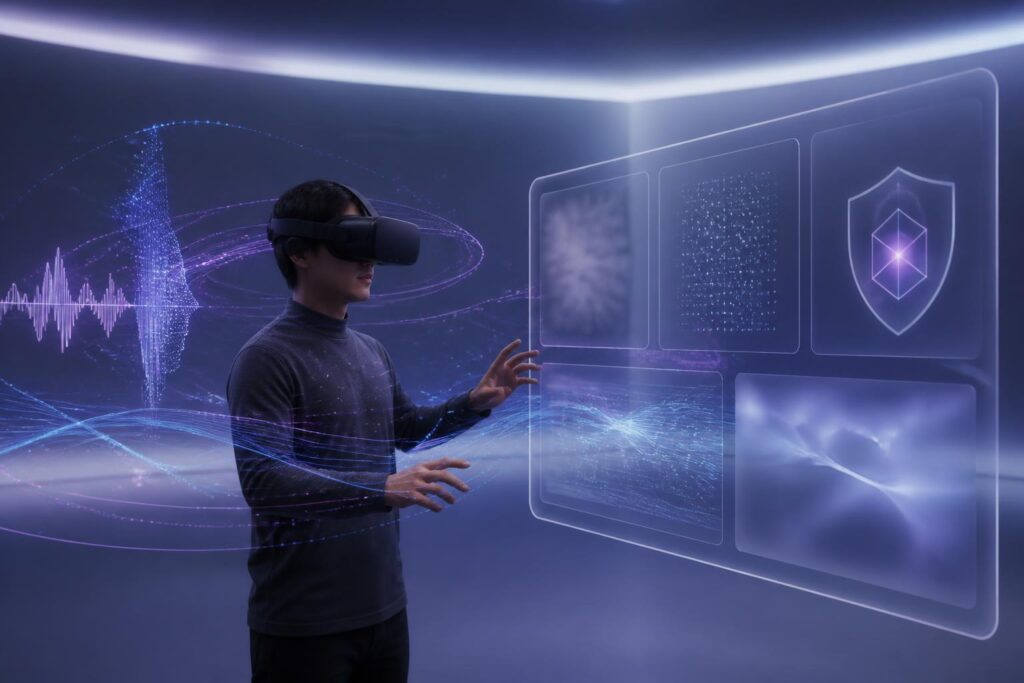
In highly interactive virtual spaces, users do not merely send text or still images. They enter through their voices, head movements, gaze direction, hand gestures, and the way they respond to those around them. Each action makes the experience feel more natural, but at the same time creates another layer of data about the person. This is what makes privacy in the virtual world different from privacy in many familiar online environments.
A social media account may reveal what users like, whom they follow, or where they often appear. A virtual space capable of tracking movement can provide subtler signals: which objects users look at, how they react when someone approaches, how long they pause in front of content, and how their behavior changes in social situations. Not all such data is collected or used in the same way, but its existence raises an important question: when presence is digitized, where does the boundary of privacy lie?
More Than Login Data
Privacy in the virtual world is often discussed through familiar issues such as passwords, account takeovers, or payment information. These risks remain important, but they do not fully reflect the characteristics of immersive environments. A virtual reality device or motion-tracking system may process many types of signals to create the feeling that users are truly present in a digital space.
Voice may be used for communication, but it can also reveal identifying characteristics and information about the surrounding context. Head and hand movements help virtual characters respond naturally, yet they can also show how a person focuses, hesitates, or interacts with an object. Gaze direction is a particularly sensitive case. Where a person looks over a period of time may reveal their interests, attention, or reaction to a situation that they have not deliberately expressed in words.
It is important to distinguish between data necessary to operate an experience and data that is stored, analyzed, or shared for other purposes. A system may need movement information in real time to control an avatar, but that does not automatically mean every movement record must be retained for a long time. This principle may seem simple, but in practice users often find it difficult to know which data is processed only temporarily, which data is stored, and who can access it.
Consent Should Not Be a Mechanical Click
In many digital services, users encounter a long terms-of-service screen and are asked to click “agree” before beginning. This approach becomes even more limited when applied to the virtual world, because the data involved may be directly related to the body, voice, and social relationships. A single “consent” choice covering all purposes does not help users understand how far they are granting permission.
Consent is more meaningful when it is divided according to specific purposes. Users should be able to allow movement data to be processed to control an avatar while refusing its use for advertising or behavioral analysis. They should also know when the microphone, camera, or sensors are active, what information is sent outside the device, and how to withdraw permissions they have granted. These choices should be presented in language that is easy to understand, rather than appearing only in difficult-to-read legal documents.
Privacy also cannot be viewed solely as an individual decision. When someone takes part in a meeting or performance in a virtual space, the voices and avatars of other people may appear as well. A person who turns on a recording feature may unintentionally create data involving many people who did not want to be recorded. Therefore, privacy-protective design needs to take into account everyone present in the same space, not just the person who owns the device.
Flexible Identities and the Risk of Being Tracked
One of the attractions of the virtual world is the ability to experiment with self-expression. Users can choose an avatar, display name, and communication style that differ from those in everyday life. This flexibility can help many people feel more confident, take part in new communities, or explore roles they have never tried in face-to-face environments.
However, a flexible identity does not mean that users are completely anonymous. If login sessions, communication histories, movement patterns, and activities across multiple spaces are linked together, an avatar can gradually become a stable identifying trace. The risk does not lie only in someone learning a person’s real name. Knowing where someone usually appears, which groups they connect with, or when they tend to be active can also undermine privacy.
The ability to link identities also affects the right to start over. A person may want to leave a community, change how they present themselves, or separate personal activities from work. If a platform retains too many links between accounts and does not allow users to control their history, they may find it difficult to truly create a new space. This is particularly noteworthy for minors and people who participate in sensitive communities.
Social Safety Must Go Hand in Hand with Privacy
The virtual world is not concerned only with data collection. The way users treat one another in that space also determines whether they feel safe. Verbal harassment, invading the personal space of an avatar, following someone through multiple areas, or deliberately recording private moments can all make the experience uncomfortable and even harmful.
Effective safety tools should be available directly within the experience, rather than forcing users to leave the space to find a support page. People need a quick way to mute others, block accounts, create virtual distance, or report inappropriate behavior. These tools should be easy to identify without excessively interrupting normal activity. Users also need to understand what happens after they submit a report, what data is used to process it, and how they can appeal.
This creates a difficult balance: platforms need enough information to investigate harmful behavior, but they should not turn every interaction into an indefinite surveillance file. Storage should have a clear purpose, a reasonable time limit, and restricted access. A record created to handle a complaint should not automatically become material for every other form of analysis.
Designing for Privacy from the Start
Privacy will be difficult to ensure if it is added only after a product has been completed. Fundamental choices need to be made from the design stage onward. For example, a system could prioritize processing certain signals on the device instead of sending all the data to a server. Data that is not necessary for the main function need not be collected. Information that is no longer needed can be deleted or converted into a form that is less closely linked to an individual.
The interface also plays an important role. A small indicator showing that the camera is active, a control for adjusting the distance between avatars, or an easily accessible privacy dashboard can make a major difference. Users should not have to understand technical terminology to know who is listening to them, who is allowed to interact with them, or what type of data they are sharing.
Transparency is not limited to publishing a policy. Platforms need to explain through specific situations: what data is used when a user joins a class, what happens when they record a gathering, how to delete voice history, or how to separate a personal account from a work account. Explanations like these help users make more practical decisions than a generic list of concepts.
Users Need a New Habit
Technology has a responsibility to protect users, but individuals also need to develop habits suited to immersive environments. Before entering a new space, users should check the permissions for the microphone, camera, and sensors; review who can send them invitations or approach them; and learn how to block and report accounts. For meetings involving sensitive content, considering whether to record or reshare the session is just as important as protecting the account.
Families, schools, and workplaces need to discuss these issues in accessible language. Children can understand that an avatar is not an absolute suit of armor, while adults need to recognize that a virtual conversation can still have real consequences. Organizations that use virtual spaces for training or collaboration should establish clear rules regarding audio recording, video recording, storage, and the right to leave an interactive session.
More importantly, users need to be given the power to choose rather than merely being asked to accept or leave. A trustworthy virtual world is not one without data, but one in which data is collected within limits, used for its intended purposes, and subject to understandable control.
Privacy Determines the Quality of Presence
The more closely the virtual world resembles everyday life, the deeper the questions about privacy become. When gaze, voice, and gestures help create a sense of presence, they cannot simply be treated as anonymous technical signals. They are connected to people’s emotions, habits, and relationships.
If users are constantly worried that every action is being recorded or could be used for another purpose, they will limit how they participate. Conversely, when there is clear information, meaningful control tools, and fair protection mechanisms, they can interact more openly. Privacy is therefore not an obstacle to the virtual world. It is the condition that allows presence in digital spaces to be voluntary, safe, and meaningful.
