


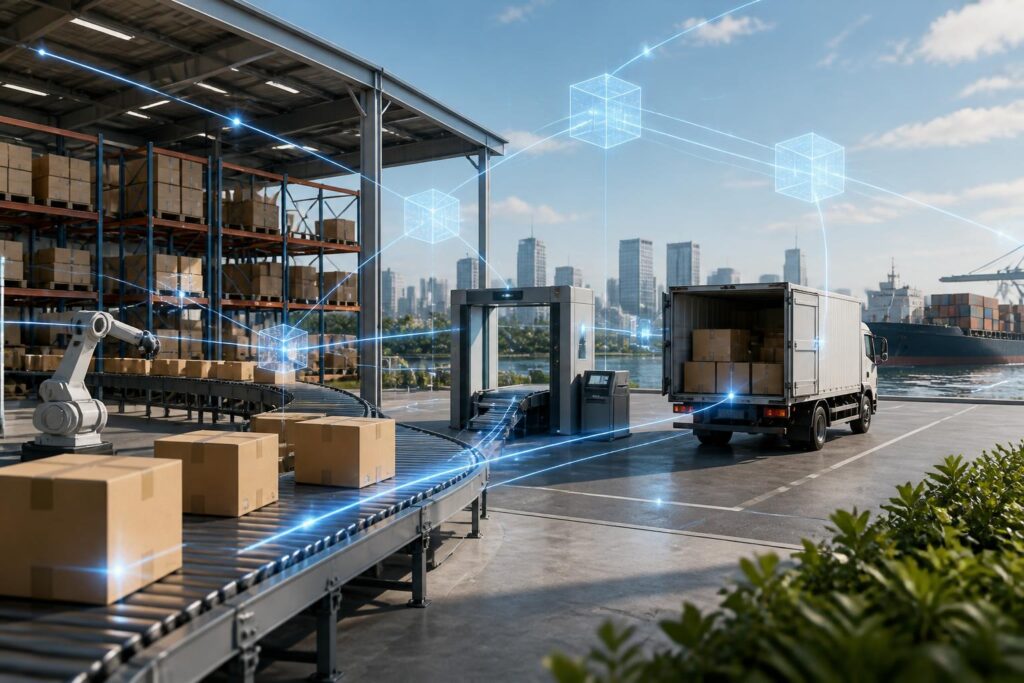
In a product that reaches consumers, information about the source of raw materials, the place of production, the transportation process, and each handover is often scattered across multiple businesses. Each party may use its own management system, coding conventions, and storage procedures. When a shipment needs to be checked, piecing these fragments of information together can sometimes be time-consuming, especially if the data is exchanged through paper documents, spreadsheet files, or inconsistent channels.
Blockchain is often mentioned as a way to record transaction histories and the movement of goods in a manner that makes them difficult to alter discreetly. However, the assumption that blockchain automatically turns every product into a transparently sourced commodity is inaccurate. This technology can support data traceability, cross-checking, and access control, but its ultimate effectiveness still depends on data-entry procedures, verification devices, and the honesty of the participating parties.
What Can Blockchain Do in the Supply Chain?
In essence, blockchain is an electronic ledger maintained by multiple computers within the same network. New records are generally arranged in chronological order and linked to previous records. Depending on the design, the network may require the parties to validate the data through a consensus mechanism before a record is added.
In a supply chain, each shipment or product unit can be linked to an identification code. When goods move from a raw-material supplier to a manufacturing facility, and then to a transport provider or distributor, the relevant events can be recorded in the system. These events may include the handover time, the responsible party, inspection status, or accompanying documents, depending on the scope of the data that the businesses agree to share.
A notable point is that blockchain creates a shared history for the parties authorized to participate. Instead of each business keeping only its own version of the data and manually comparing them when a dispute arises, the parties can jointly refer to a chain of confirmed records. When an old record is altered, inconsistencies can be detected more easily than in a model based solely on an internal database.
The Value of Traceability
Traceability is not intended solely to support marketing activities. In many industries, knowing which stages a product has passed through can help with quality control, handling the discovery of defects, and carrying out recalls within the proper scope. If the information is well organized, businesses can isolate the relevant shipments instead of having to inspect all products of the same type.
Blockchain can also clarify responsibility among the parties. A supply chain often has many handover points, and each point creates a risk of confusion or missing data. Recording the party involved, the time, and the conditions of the handover helps establish an audit trail. This trail does not automatically determine who is at fault when an incident occurs, but it can provide a basis for reviewing procedures and identifying when the problem emerged.
For buyers, traceability information can be displayed through a scannable code on the packaging or through a company application. However, data intended for consumers needs to be selected and presented in an easy-to-understand way. A long string of technical codes does not necessarily amount to useful information. Users are more concerned with specific questions such as where and when the product was made, which inspection stages it passed through, and who provided that information.
Blockchain Cannot Verify Everything in the Real World
The greatest limitation of this model lies in the input data. Blockchain can help protect a record after data has been entered into the system, but it does not know whether an employee entered the correct quantity, location, or condition of the goods. If the initial information is wrong, preserving it for a long time does not make it true.
For example, a shipment may be recorded as having been stored at a suitable temperature. But if the sensor is faulty, has not been calibrated, or has not been placed in the correct position, the recorded data may not reflect the actual conditions. Similarly, a product code may be scanned at multiple points, but the system still needs a mechanism to ensure that the code is correctly linked to the goods and has not been copied or transferred to another product.
For this reason, blockchain in the supply chain generally needs to be combined with multiple other layers of control. Businesses may use anti-counterfeiting identifiers, sensor devices, inventory procedures, independent audits, and access controls for data entry. Each layer addresses a different risk. Blockchain is only one component of the overall architecture, not a replacement for physical controls and human accountability.
Questions to Answer Before Implementation
First, a business needs to identify the actual problem it wants to solve. If the difficulty lies only in the fact that departments have not agreed on software or procedures, upgrading the database and standardizing operations may be more appropriate than building a blockchain network. New technology is valuable only when it addresses a clear need at an acceptable cost and level of complexity.
The next question concerns the participating parties. A supply chain is usually not under the control of a single business. A shared system works effectively only when suppliers, logistics providers, distributors, and inspection parties agree on data formats, access rights, and update responsibilities. If only one party records data while the others do not participate, the system will struggle to provide a complete picture.
Privacy also needs to be considered from the outset. Data about purchase prices, output volumes, customers, or contract terms may be sensitive information. Not all data should be made public to the entire network. A suitable design may store only minimal information on the blockchain, while detailed documents are kept in separate systems and provided only to authorized parties. This approach helps balance auditability with confidentiality requirements.
Operating costs are another factor that is easily overlooked. Businesses must pay not only for the initial software or infrastructure, but also for training personnel, maintaining equipment, managing accounts, supporting partners, and updating procedures when products change. If users at handover points find the system too complicated, they may enter data carelessly or find ways to bypass the process, reducing the quality of the entire system.
From Technology Pilots to Practical Value
A blockchain project in the supply chain should begin at a manageable scale. A business can select a group of products, a transportation route, or several partners willing to cooperate. The initial goal should not merely be to prove that blockchain can work, but to measure outcomes such as the time required to cross-check data, the proportion of complete records, the ability to detect discrepancies, and the convenience for users.
During the pilot phase, it is necessary to clearly distinguish which data is recorded automatically, which data is entered by people, and which data is verified by a third party. This distinction helps assess the reliability of each record accurately. Information recorded automatically by a controlled device may be evaluated differently from information manually entered by an employee several hours after the handover.
Businesses also need to establish error-correction procedures. The difficulty of altering blockchain records does not mean that recorded data can never be adjusted. In practice, data-entry errors, status changes, or requests for updates based on new inspection results may arise. The appropriate approach is usually to create an additional record showing the adjustment, preserving the history rather than deleting the old trail in a nontransparent manner.
Viewing Blockchain with Realistic Expectations
Blockchain can provide value when multiple parties need to record a shared transaction history but do not want to depend entirely on a single database. In that context, the ability to create records that are sequential, permissioned, and easy to cross-check can help supply chains operate more transparently. The technology also opens up ways to connect data across stages that were often separated in the past.
Even so, the transparency of a system does not automatically mean that the real-world product is accurate. For traceability to be meaningful, businesses must address the issues of product identification, data quality, partner capabilities, privacy, and verification responsibilities at the same time. Without these conditions, blockchain risks becoming an expensive technological layer placed on top of an unstandardized process.
The most cautious approach is to view blockchain as a tool that supports trust among parties, not as an absolute guarantee of origin. When placed within a system with clear procedures, reliable input data, and independent verification mechanisms, blockchain can make the history of goods easier to track and more difficult to alter arbitrarily. Its true value therefore does not lie in the technological terminology, but in how the technology helps people coordinate, verify information, and take responsibility more effectively.
