

Blockchain is often described as a system capable of recording and verifying data without a single central authority. However, most blockchain networks only know what has happened within themselves. A smart contract can check token balances, transaction status, or the outcome of a condition recorded on-chain, but it does not inherently know today’s gold price, whether a flight has been canceled, or what score a match ended with.
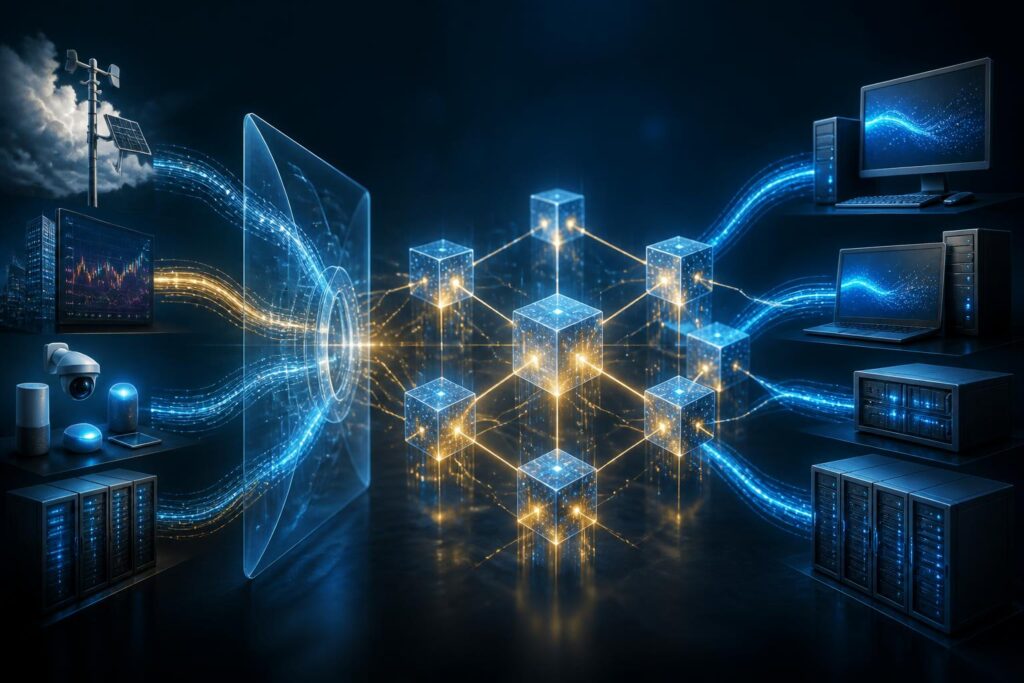
The gap between on-chain data and real-world events is filled by blockchain oracles. This is an infrastructure layer that supplies external data to smart contracts so that automated programs can make decisions. An oracle is not merely a simple data transmission channel. It involves how data is collected, compared, submitted to the blockchain, and handled when information sources do not agree. Understanding oracles correctly is therefore very important when evaluating decentralized applications.
Why do smart contracts need oracles?
Smart contracts have the advantage of executing according to programmed rules. Once a condition is met, a program can automatically transfer assets, update a status, or distribute benefits. However, this automation is valuable only if the program’s inputs are reliable. If a contract receives incorrect data, it may still execute the written code correctly but produce an incorrect result in reality.
Imagine an automated insurance product that pays out when rainfall in a certain area exceeds a specified threshold. A smart contract can process the payment very quickly, but it needs a data source indicating the actual rainfall. Similarly, a lending platform needs asset price data to determine the value of collateral and the safety of a loan. A prediction market needs to know how an event unfolded before distributing rewards.
Blockchain does not directly access databases, sensors, information websites, or external enterprise systems. This limitation is often considered part of its security model. Every node in the network can verify the same on-chain data, but allowing each node to connect arbitrarily to external sources would make the results inconsistent. Oracles were created to provide an intermediary mechanism that blockchain applications can use.
What layers do oracles operate through?
An oracle system usually involves multiple stages rather than simply taking data from one source and sending it directly to the blockchain. First, data is collected from one or more external sources. These sources may include exchanges, data providers, sensor systems, enterprise platforms, or specialized services. The data may then be standardized so that different sources use the same units, formats, and timestamps.
In the next step, the system may aggregate or compare multiple responses. If one source provides an abnormal price, the aggregation mechanism may remove that data or reduce its influence. The final result is sent to the blockchain through a transaction. The smart contract receives this information and executes its programmed logic, such as adjusting the collateral ratio or disbursing a payment.
The process above highlights an important point: the immutability of blockchain does not automatically make input data correct. Blockchain can prove that a value was recorded and was not changed through ordinary means, but it does not necessarily prove that the value accurately reflects the outside world. An oracle is therefore a layer of trust between the real world and the distributed ledger.
Common oracle models
Centralized oracles obtain data from a single entity. This model can be simple, fast, and easy to deploy, but it creates a clear point of failure. If the provider experiences a disruption, is attacked, comes under pressure, or supplies incorrect information, applications dependent on that data may be affected. In some internal cases, when the data source is controlled by an organization with specific legal responsibility, this model may still be appropriate. However, it should not automatically be regarded as decentralized.
Decentralized oracles use multiple data sources or multiple operators to reduce dependence on a single entity. The parties may submit separate responses, after which the system applies an aggregation rule such as a median, a consensus threshold, or another mechanism. This model increases resistance to isolated errors, but it also creates requirements concerning economic incentives, operating costs, and how to handle situations in which most sources are wrong in the same way.
User-supplied oracles are used in situations that require confirmation of a specific event. Participants may submit evidence or answers, while other parties have an opportunity to challenge them. Some designs also require collateral to limit fraudulent behavior. This model shows that an oracle does not necessarily have to be a continuous data stream; it can also be a dispute-resolution process.
There are also hardware oracles, which obtain data from devices or sensors, and software oracles, which obtain data from digital systems. The boundaries between these models are not always absolute. An application may combine multiple types of oracles, use different data sources for important conditions, and add a pause mechanism when the data shows signs of abnormality.
Risk does not lie solely in the source code
In blockchain applications, users often focus on smart contract bugs because source code can be exploited. Oracles show that risk also lies in the data and the process of bringing data into a contract. A price source manipulated for a short period can cause collateral to be mispriced, create improper liquidations, or allow a party to borrow beyond a safe level.
Risk can also arise when data sources do not update at the same time. A continuously operating market may reflect a new price faster than another system. If a contract uses unsuitable timestamps, this discrepancy can create abnormal arbitrage opportunities. In areas such as insurance or event-based payments, delayed data can also change the outcome even when the final information is accurate.
Another issue is the ambiguity of the event itself that needs to be verified. With price data, the seemingly simple question is which market the price comes from, over what period, and in what unit. For a real-world event, it is necessary to define what counts as its beginning, ending, cancellation, or a change in conditions. If the rules are not defined in advance, disputes may arise even if the oracle system transmitted the data correctly according to its design.
Cost is also a technical factor. Updating data too frequently can increase transaction costs and put pressure on the network. Updating too infrequently, however, can make the data outdated. Therefore, oracle design must balance freshness, accuracy, resistance to manipulation, and cost. There is no update frequency suitable for every application.
Evaluating an oracle before using it
Users and developers should not look only at the name of an oracle protocol. They need to ask where the data comes from, how many sources there are, according to what criteria the sources are selected, and who has the authority to change the configuration. They should also consider how the system responds when a source goes offline, produces a significantly different value, or is suspected of having been compromised.
Economic security mechanisms also deserve scrutiny. If data providers can gain benefits far greater than the cost of cheating, requiring them to act honestly may not be strong enough. Conversely, if penalties are excessively severe or the appeals process is unclear, honest participants may not want to operate the system. Incentives must be tied to data quality and the ability to detect deviations, rather than merely encouraging the rapid submission of data.
Applications should also have measures to limit losses. Price-change thresholds over a given period, pause mechanisms, payment-size limits, and additional confirmation requirements may slow some activities, but they help prevent a single abnormal data point from causing irreversible consequences. In asset-management systems, speed is not always more important than the ability to control risk.
Oracles and the problem of trust in blockchain
Blockchain is often expected to reduce the need to trust intermediaries. Oracles show that trust does not disappear but is redistributed. Instead of trusting only a bank or a centralized platform, users may have to trust a network of data providers, the method for aggregating responses, the people who manage the configuration, and the dispute-resolution process.
This does not make oracles meaningless. The practical goal is not to eliminate all trust, but to make trust assumptions transparent, verifiable, and limited. A good system needs to tell users what data is being used, who is responsible at each layer, what happens when data is unavailable, and how losses are limited.
In the future, blockchain applications may combine multiple verification methods instead of relying on a single data stream. Cryptographic proofs, signatures from designated parties, data directly from devices, and dispute mechanisms can complement one another. However, technology is only one part of the problem. Operating rules, legal responsibility, and user-experience design will still determine whether the system is trustworthy in practice.
Oracles are a little-seen infrastructure layer that directly influences many activities on blockchain. They transform off-chain data into inputs for automated programs while also bringing questions about information sources, control, and responsibility to the center of design. When evaluating a decentralized application, checking the smart contract is necessary but not sufficient. It is also necessary to examine the path the data takes before becoming part of an on-chain decision.
