


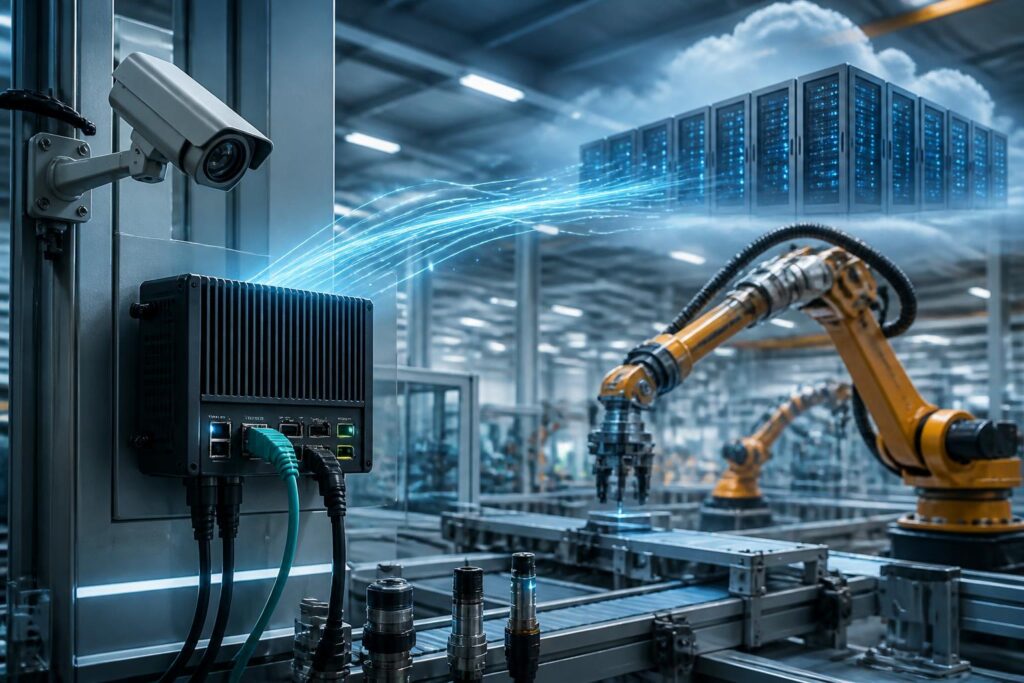
For many years, most data from cameras, sensors, machinery, and mobile devices was sent to data centers or cloud platforms for processing. This centralized model made it easier for businesses to manage resources, deploy software consistently, and expand capacity as needed. However, as the number of connected devices has increased, this approach has begun to reveal its limitations. Not all data needs to travel a long distance before triggering an action, especially in situations that require an almost instantaneous response.
Edge computing emerged to address this problem. Instead of sending all data to a remote processing center, the system places computing capacity at or near the place where the data is generated. A small server in a factory, a processor integrated into a camera, a network device in a store, or a cluster of computers located near a telecommunications station can all become an edge node. Data can still be synchronized to the cloud, but tasks requiring a fast response are processed immediately on-site.
How Is Edge Computing Different from Cloud Computing?
Edge computing is not a complete replacement for cloud computing. The two models often complement each other. The cloud is well suited to long-term data storage, artificial intelligence model training, large-scale analysis, and centralized resource management. Meanwhile, the edge layer handles tasks close to devices, where latency, continuous operation, or requirements to limit data transmission are particularly significant.
A system can be envisioned as consisting of three layers. The device layer generates data through temperature sensors, cameras, robots, or scanners. The edge layer is located near these devices and is responsible for filtering, analyzing, and responding quickly. The cloud or data center layer receives selected data for storage, training, aggregation, and monitoring on a broad scale. The boundaries between the layers are not fixed. Some tasks can run directly on the device, some can be transferred to an edge server, while heavier workloads will be sent to the cloud.
The Greatest Value Lies in Response Speed
The most obvious benefit of edge computing is reduced latency. On a production line, a camera can detect a misaligned product and send an adjustment signal right in the machinery area, instead of waiting for the data to travel across a wide-area network before receiving a command. In transportation, a system at an intersection can analyze images and adjust signal cycles based on actual conditions. In a hospital, monitoring equipment can alert staff when an indicator is abnormal without depending entirely on a connection to an external service.
Not every application requires an extremely short response time, but even when latency is reduced only moderately, the user experience and system stability can improve. A store with many cameras, for example, does not necessarily have to continuously transmit all high-resolution video streams to the cloud. An on-site processor can identify events that require attention and send only the relevant data segments for storage or further examination.
Reducing the Amount of Data That Must Move
Cameras, industrial sensors, and personal devices generate enormous amounts of data. If all data is transmitted intact to a processing center, businesses face increasingly high transmission costs, bandwidth requirements, and storage pressure. Edge computing allows systems to filter data before transmitting it. Duplicate information or information with no analytical value can be removed, while important events are retained as records, metrics, or shorter data segments.
This approach does not mean that raw data is always deleted. Depending on business requirements, a system may store data locally for a period of time, compress the data, or transmit only extracted features. Decisions about how to process data should be based on its intended use, legal obligations, audit requirements, and recovery capabilities. Businesses should not assume that reducing transmitted data is always better if doing so eliminates information needed to investigate incidents.
Fields That Can Benefit Significantly
Factories are one of the environments well suited to edge computing because they contain many specialized devices, processes that require stable responses, and situations in which continuous dependence on an Internet connection is sometimes impossible. An edge node can collect data from machinery, monitor operating conditions, detect signs of anomalies, and coordinate with control systems. When the connection to the cloud is interrupted, core functions can continue operating if they have been designed to work independently.
In retail, edge processing can support inventory management, customer traffic analysis, or monitoring of equipment in stores. In transportation and logistics, edge nodes located at warehouses, ports, or vehicles can analyze data directly at the site. In agriculture, equipment on a farm can combine information from soil sensors, weather systems, and irrigation systems to make appropriate adjustments without continuously transmitting all data to a remote server.
Healthcare is also a field in which this model requires careful consideration. Some devices can perform initial processing at the point of care to provide a fast response or reduce the transmission of sensitive data. Nevertheless, edge computing does not automatically resolve requirements concerning the security of medical records. Systems still need access controls, encryption, activity logging, clear assignment of responsibilities, and compliance with relevant regulations.
Bringing Artificial Intelligence Closer to Devices
The development of artificial intelligence models has made edge computing more noteworthy. A system for image recognition, abnormal sound detection, or signal classification can run directly on a device or on a server near the data source. In that case, the system does not need to send entire images or audio recordings to the cloud merely to obtain a simple result.
However, running models at the edge involves its own trade-offs. Edge devices generally have more limited computing capacity, memory, and cooling space than data centers. Models must be optimized to use fewer resources, while version updates need to be tightly controlled. A model that performs well in a laboratory may produce different results when lighting, noise, viewing angles, or operating conditions change. Therefore, businesses need to monitor output quality after deployment instead of considering model installation the final step.
Security Challenges Do Not Disappear
Distributing computing capacity across multiple locations reduces dependence on a single center, but it also broadens the attack surface. An edge server in a factory, a network device in a store, or a controller in a remote area can all become targets if they are not properly protected. These devices are sometimes located in environments that are difficult to access, use specialized software, and are not updated regularly.
An edge computing architecture should begin with device and user authentication, least-privilege access, and encryption of data both in transit and at rest. Businesses should have secure boot mechanisms, key management, remote updates, and software integrity checks. Each edge node should also be recorded in an asset management system so that the organization knows which devices are operating, which versions they use, and which department is responsible for them.
Another important point is designing the ability to respond when a device is isolated or compromised. The system needs ways to detect abnormal behavior, revoke access, isolate a node experiencing problems, and restore a trusted configuration. If an organization focuses only on protecting the data center while neglecting devices in the field, it may create a major gap in its information security chain.
Operations Are Often More Difficult Than Buying Equipment
Many edge computing projects fail not because of a lack of hardware but because of a lack of operational processes. As the number of processing nodes increases, businesses must monitor the status, temperature, storage capacity, connection quality, and performance of each device. Software updates also need to be planned so that they do not disrupt an operating production line or service.
Before deployment, businesses should clearly determine which tasks need to be processed at the edge, which tasks are suitable for the cloud, and which data must be retained. A small-scale pilot project can help assess stability, resource consumption, result quality, and operating costs. After that, the model should be expanded in stages, together with specific measurement criteria. Introducing the technology at every point simply because it is a trend often creates a more complex system without necessarily delivering commensurate value.
The Future Is a Combination of the Edge, the Cloud, and Devices
Edge computing will not make data centers obsolete. The practical trend is likely to be a flexible combination of multiple processing layers. Devices will handle simple operations that require a fast response. Edge nodes will process data within a site or region. The cloud will perform aggregation, model training, long-term storage, and coordination at large scale.
The value of this model does not lie in where data is processed in an absolute sense, but in the ability to place the right task in the right location. When businesses clearly understand their requirements for latency, privacy, continuity, cost, and operational capacity, edge computing can become a practical infrastructure layer for digitalization. It brings technology closer to where decisions are made, while also requiring organizations to think more seriously about how data is collected, used, and protected.
