


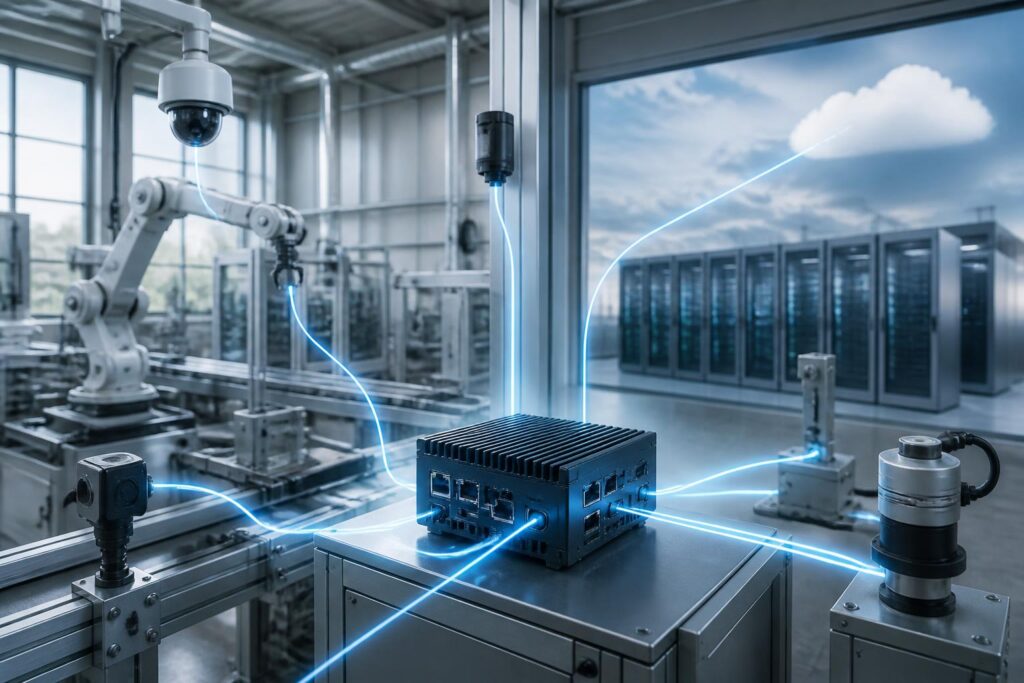
Every day, phones, cameras, industrial sensors, smart vehicles, and many other devices generate vast amounts of data. The familiar approach is to send that data to a data center or cloud platform for processing, then send the results back to the device. This model still plays an important role, but it is not always suitable. When a system needs to respond quickly, operate under unreliable connectivity, or process sensitive data, sending all information elsewhere can create unnecessary latency, costs, and risks.
Edge computing has emerged as an alternative way of organizing these processes. Instead of concentrating all processing in a center far from users, this model brings some computing and storage capacity closer to where the data is generated. An edge device may be a small server installed at a factory, a controller in a store, a gateway connecting multiple sensors, or network infrastructure capable of processing data locally. The cloud can still be used, but it is no longer the only place responsible for all operations.
How Does Edge Computing Work?
In a conventional system, a sensor records data and then transmits it over a network. A remote server analyzes the information, produces a result, and sends back a response command. With edge computing, a processing layer is placed between the endpoint device and the data center. This layer can filter, organize, conduct preliminary analysis, or make decisions in situations that require an immediate response.
For example, a production line may use cameras to detect products that fail to meet requirements. If all images are sent to the cloud, the system must transmit a large amount of data and depend continuously on the network connection. An edge computer placed near the production line can analyze images on-site, sending only inspection results or cases requiring further review to the central system. This approach reduces the amount of data that must be transmitted and helps keep the process from depending entirely on an external connection.
Edge computing does not necessarily mean that all data must be processed locally. In practice, systems often divide the work. Tasks requiring rapid response are handled at the edge, while aggregated data, operational history, or tasks requiring substantial resources can be sent to the cloud. This is a hybrid model in which device, network, edge-server, and cloud-platform layers work together.
Why Are Businesses Interested in This Model?
The most obvious benefit is the ability to shorten the distance data has to travel. When a decision is made near the device generating the data, the system can respond more quickly than a process that must send a request to a remote server. This is especially meaningful in situations requiring continuous monitoring or real-time reactions, such as machine control, safety monitoring, traffic management, and remote equipment operation.
Edge computing also helps reduce pressure on networks. Not all data needs to be stored or transmitted in its entirety. A camera may continuously capture images, but the system may only need to send an alert when it detects a specific condition. A factory sensor may transmit abnormal readings instead of continuously uploading the entire stream of raw data. Filtering data early not only saves bandwidth but also helps the central system focus on more valuable information.
The ability to continue operating when connectivity is unstable is another notable advantage. An appropriately configured edge device can perform essential functions while disconnected from the cloud. When the connection is restored, the necessary data can be synchronized with the central system. However, the degree of independence depends on the specific design. Not every edge device has enough capacity to replace all cloud services.
In some cases, local processing also supports privacy requirements. Sensitive data can be analyzed or have its level of identifiability reduced before it leaves the location where it was generated. For example, a system may store only statistical results instead of transmitting all the original data. Even so, edge computing does not automatically guarantee information security. Privacy depends on how data is collected, used, stored, access-controlled, and deleted.
Fields That Can Benefit
In manufacturing, edge devices can monitor the condition of machinery, detect signs of abnormalities, and support predictive maintenance. Data from multiple sensors is analyzed near the production line, helping operators identify problems before a failure spreads. The system can still send aggregated data to a central facility for comparison across shifts, factories, or operating periods.
In retail, edge processing can support inventory management, monitoring of in-store equipment, and analysis of activity at each location. Tasks requiring rapid responses can be performed directly in the store, while long-term reports are stored and analyzed centrally. This division helps branches operate more flexibly, but it also requires businesses to closely control software and equipment across multiple locations.
For transportation and urban environments, data from cameras, street sensors, and vehicles can be processed near where it is generated to support coordination. Such a system can prioritize alerts requiring rapid responses instead of waiting for all data to be sent to a central facility. In buildings, edge computing can connect air-conditioning, lighting, access-control, and environmental-sensor systems so they can adjust to actual conditions.
In healthcare, this model can support the processing of data from on-site monitoring devices. However, this is a field with stringent requirements for accuracy, security, and professional accountability. An edge system should be deployed only within a scope that has been appropriately assessed, tested, and governed; it cannot by itself replace professional procedures or decisions made by healthcare workers.
The Challenges Are Not Limited to Hardware
Deploying edge computing is not simply a matter of buying additional small servers and placing them next to devices. Businesses must manage many distributed operating points, each of which may face different conditions involving temperature, power, networking, and security. A configuration error on a single edge device can affect the data or operations of an entire site.
The software life cycle also becomes more complex. Devices need to be updated, monitored, and replaced according to a plan. If a business focuses only on protecting its data center while neglecting gateways or computers installed in the field, attackers may try to gain access through a less closely watched link in the chain. Each device needs its own identity, authentication mechanisms, least-privilege access controls, and the ability to record events for inspection.
Distributed data also raises governance questions. Businesses need to determine which data is stored locally, which data must be transferred to a central facility, how long it should be retained, and who is authorized to access it. If different locations apply different rules, reconciliation and auditing will become difficult. Therefore, an edge-computing architecture needs to be accompanied by consistent policies rather than being treated merely as a standalone technical project.
Costs must also be calculated in full. Reducing the bandwidth used to transmit data to a central facility may create benefits, but businesses must also invest in equipment, management software, support personnel, and contingency arrangements across multiple locations. A model that is technically beneficial may not be economically suitable if the volume of data is small, response-time requirements are modest, or the existing infrastructure already meets needs effectively.
A Practical Approach to Deployment
The first step is to identify the problem that needs to be solved rather than starting with a technology currently being promoted. Businesses should consider the type of data being generated, the required response time, the degree of dependence on connectivity, security requirements, and operating costs. If an application does not require rapid processing or involve very large amounts of data, adding an edge layer may make the system more complex without delivering commensurate benefits.
Next, it is advisable to begin with a limited scope and clear evaluation criteria. A small trial could focus on the ability to maintain operations during a network outage, the amount of data offloaded, response times, error rates, and the administrative effort required. Actual results will help the business decide whether to expand, adjust, or stop the deployment.
The architecture must also account for situations in which an edge device fails. The system must have ways to detect errors, restore configurations, store data temporarily, and synchronize data after connectivity returns. Critical functions need contingency arrangements, while decisions with significant consequences must be designed with appropriate checking and intervention mechanisms.
The Edge Does Not Replace the Cloud
Edge computing is often described as the counterpart to cloud computing, but this interpretation can lead to extreme choices. In reality, the two models complement each other. Edge devices are suitable for processing near the data source, responding quickly, and reducing data transmission. The cloud is suitable for large-scale storage, analyzing data from multiple locations, centralized management, and deploying shared services.
The value of edge computing does not lie in moving everything out of the cloud, but in placing each task where it is most appropriate. When designed around actual needs, this model can help systems respond more flexibly, reduce dependence on network connections, and use resources efficiently. Conversely, if it is deployed merely because it is a trend, businesses may have to take on additional equipment, software, and security points.
In the coming years, the growth of connected devices and applications requiring rapid responses will continue to increase demand for edge processing. Even so, the decisive factors will remain the overall architecture, the quality of governance, and the ability to protect data. Edge computing can fulfill its intended role only when it is treated as part of an infrastructure strategy, not as an independent solution that can automatically resolve every problem.
