


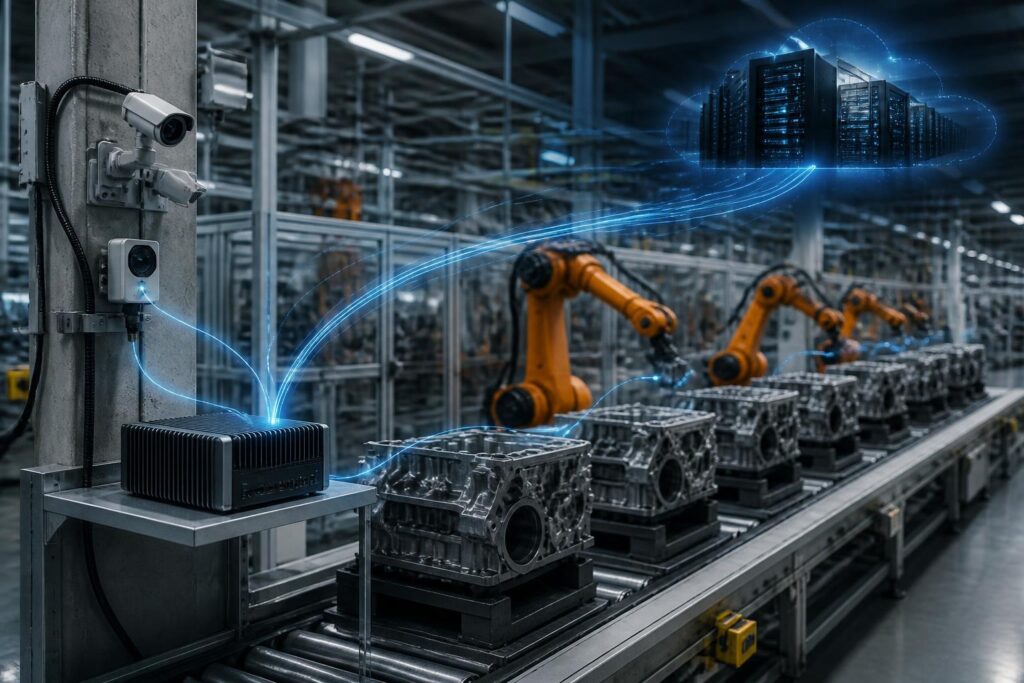
For many years, the common approach to data processing was to send information from a user’s device to a remote data center, perform the computations there, and then send the results back. This model laid the foundation for cloud computing and enabled organizations to access substantial processing capacity without having to build all the infrastructure themselves. However, as the number of connected devices has grown and applications have increasingly demanded fast responses, sending all data to a centralized location has begun to reveal its limitations.
Edge computing has emerged as a complementary approach. Instead of requiring data to always travel to a data center, this model brings some storage and processing capabilities closer to where the data is generated. This could be a server in a factory, a network device in a store, a computer located in a hospital, or a specialized device right next to cameras, sensors, and machinery. The goal is not to eliminate cloud computing, but to distribute workloads more appropriately between the cloud and processing points located closer to users.
Why Does Data Need to Be Processed Near Its Source?
The most noticeable benefit of edge computing is reduced latency. A system that controls machinery, analyzes camera images, or supports real-time interaction needs not only accurate results but also results quickly enough. If every request must travel over a network to a remote data center, transmission time can become a significant factor. When critical processing is performed at the location where the data is generated, the system can respond more quickly and become less dependent on network distance.
This is especially useful in situations where even a small delay can affect the user experience or operations. A production line may use cameras to detect products that do not meet requirements. A store may analyze the condition of equipment on-site. An autonomous vehicle or machine may need to respond to sensor data without waiting for a connection to an external server. In such cases, edge processing gives the system greater ability to operate independently, although it can still synchronize aggregated data to the cloud afterward.
Edge computing also helps reduce the amount of data that must be continuously transmitted over a network. High-resolution cameras, industrial sensors, and measurement devices can generate enormous volumes of information. If all raw data is sent to a central facility, businesses must allocate substantial bandwidth and storage costs to information that does not always need to be reviewed later. Edge devices can filter, classify, or condense data before sending it onward. For example, instead of continuously sending complete images, a system may send only segments related to events identified according to operational rules.
How Is Edge Computing Different from Cloud Computing?
Cloud computing centralizes computing and storage resources in data centers and then provides them over a network. This model is suitable for tasks that require flexible scaling, centralized management, and the aggregation of data from multiple locations. Businesses can use the cloud to store operational history, train machine-learning models, create reports, or coordinate multiple systems.
Edge computing distributes some of these functions closer to the data source. An edge device can perform tasks such as collecting data, checking conditions, conducting preliminary analysis, detecting anomalies, or providing an initial response. Data that needs to be stored long term or analyzed at a large scale can then be sent to the cloud. Therefore, the two models generally do not exclude each other. They form a hybrid architecture in which the edge prioritizes fast response and continuity on-site, while the cloud handles work requiring a broader perspective and greater resources.
This division also requires businesses to clearly determine which data must be processed immediately, which data can wait, which data needs to be stored long term, and which data should not leave the location where it was generated. This is not merely a technical decision. It involves costs, operational procedures, privacy, auditability, and accountability when a system produces an incorrect result.
Fields That Could Benefit
In manufacturing, edge devices can receive data from sensors and machinery to monitor operating conditions. The system can detect an abnormal sign, send an alert to employees, or activate an inspection process according to rules established in advance. On-site analysis helps factories avoid becoming completely dependent on connections to external systems while also reducing the amount of raw data that needs to be transmitted.
In retail, edge processing can support equipment management, monitor the operating condition of stores, or analyze technical signals at the point of sale. In transportation, data from cameras, sensors, and control devices can be processed near an intersection or vehicle to shorten response times. In healthcare, some systems can use on-site computing capabilities to support the collection and analysis of equipment data, while the storage, sharing, and use of information must still comply with professional procedures and appropriate security requirements.
Edge computing can also support locations with unstable network connections. A remote facility or a system that frequently operates under interruption can continue performing essential functions on-site. When connectivity is restored, data and operational status can be synchronized according to established policies. However, offline operation does not automatically appear simply because a business installs an edge server. It needs to be designed from the outset, including mechanisms for temporary storage, conflict resolution, and recovery after incidents.
Challenges of Bringing Computing Capabilities to the Edge
Distributing infrastructure means that businesses must manage more devices across more locations. A centralized data center can be monitored and updated according to a unified process, while edge devices are often located in stores, factories, buildings, or hard-to-reach places. Without centralized management tools, updating software, monitoring machine health, and resolving errors can quickly become complicated.
Cybersecurity is another challenge. Each edge device can become a point that needs protection. Businesses must address device identity, access permissions, data encryption, activity logs, secure update mechanisms, and the ability to detect abnormal behavior. Devices located in physical environments that are not tightly controlled may also face the risk of direct tampering. Therefore, security design should not focus only on the connection between devices and the cloud; it must cover the entire device life cycle.
Costs also need to be assessed comprehensively. Reducing bandwidth or latency can provide clear benefits, but businesses must still invest in hardware, software, power, cooling, maintenance, and personnel to operate systems at multiple sites. An effective edge system should be built around actual needs. If too many functions are moved to on-site devices without a clear reason, an organization may create an additional management burden instead of solving the problem.
Compatibility between devices and software is also an important issue. Legacy systems often use different protocols, data formats, or management methods. When integrating them into a new architecture, businesses need to determine what can be retained and what must be changed. A phased deployment plan, beginning with a task of clearly defined scope, often helps reduce risk more effectively than changing the entire infrastructure at once.
The Role of Artificial Intelligence at the Edge
Artificial intelligence can increase the value of edge computing by enabling devices to analyze data right where it is generated. A model can be used to recognize patterns, detect deviations, or classify events without sending all input data to a remote server. This approach can improve response times and reduce data transmission, but it does not mean that every model is suitable for running on small devices.
Businesses need to consider model size, hardware capacity, energy consumption, accuracy requirements, and how updates will be handled as real-world data changes. A model that performs well in a test environment may produce different results when deployed across multiple locations where lighting, noise, equipment, and procedures vary. Therefore, edge AI systems need to be monitored continuously, reevaluated, and equipped with a mechanism for switching to a safe alternative when the results are unreliable.
A Practical Approach to Deploying Edge Computing
Before investing, organizations should begin by mapping data flows. They need to know where data is generated, how much is produced, what response time is required, which information is sensitive, and what will happen if connectivity is interrupted. From there, businesses can choose a specific task for a pilot, such as equipment monitoring or sensor-data filtering, rather than deploying a large architecture whose value has not yet been established.
The next step is to define the boundaries between edge devices, the internal network, and the cloud. Functions that require fast responses can be placed at the edge. Tasks that require long-term data aggregation can be performed in the cloud. Rules concerning data storage, deletion, access control, and logging should be written clearly so that both technical and operations teams understand them. During testing, metrics should include not only speed but also stability, error rates, management costs, recoverability, and the impact on workflows.
Edge computing is not an automatic solution to every data problem. Its value lies in placing the right processing capabilities in the right location, while balancing speed, cost, security, and manageability. When deliberately combined with cloud computing, this model can help systems respond more quickly, reduce dependence on network connections, and make more effective use of data.
In the future, the boundaries between devices, networks, and data centers will continue to become more flexible. Users may not see the infrastructure layers behind them, but the quality of intelligent applications will depend heavily on how those layers work together. For businesses, the important question is not whether they should chase a new trend, but which data needs to be processed where in order to support operational objectives safely and practically.
