


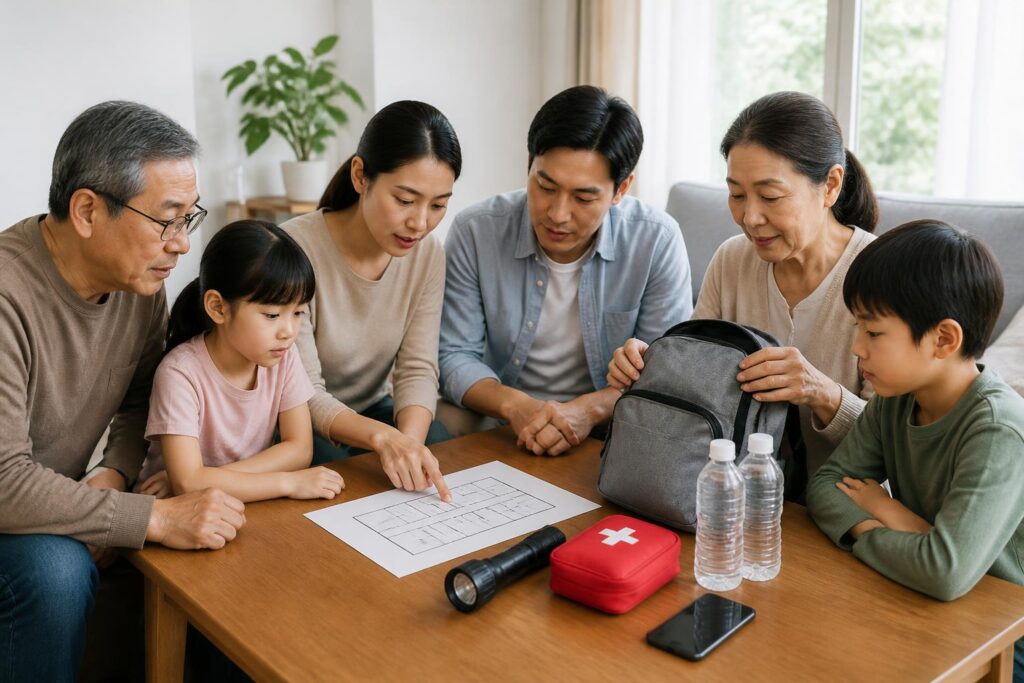
In daily life, families may face many unexpected situations, such as prolonged power outages, fires, flooding, an injured family member, a missing child, or being unable to communicate for a period of time. No one wants these things to happen, but preparing in advance is still necessary because under stress, people often find it difficult to think clearly and may easily overlook important tasks.
An emergency response plan is not a complicated set of documents or a long list of frightening assumptions. It is a way for the family to agree in advance on a few basic principles: identifying which risks may arise, deciding who is responsible for what, determining how to communicate, where to go, and which supplies should be readily available. A good plan must be easy to remember, easy to carry out, and adaptable to changes in the family.
Start with realistic risks
Every family has different living conditions, so no one should copy an existing plan exactly. Observe your home, daily routines, and the characteristics of each family member to identify the situations that deserve the most attention. A home in an area that frequently experiences heavy rain may need to focus on what to do when water levels rise or the power goes out. Families living in apartments need to understand the emergency exits, the location of stairways, and how to contact building management. A household with older adults, young children, or someone who needs assistance moving will need to prioritize care and evacuation.
There is no need to list every imaginable risk. A moderately sized list will be more useful if it focuses on incidents that could directly affect the family. They can be divided into three groups to make them easier to consider: incidents inside the home, incidents caused by weather or the surrounding environment, and situations in which family members become separated. For each group, the family should ask: What is the first sign? What needs to be done immediately? Who can help? And where is a safer place to go?
Agree on priorities
In every situation, ensuring people’s safety must come before protecting property. This principle should be stated clearly so that every family member, especially children, understands not to go back for belongings once it is necessary to leave a dangerous area. Only afterward should the family consider calling for help, caring for those affected, and protecting essential items if conditions allow.
The plan should also distinguish between situations that can be handled independently and those that require professional assistance. A minor incident may be resolved through simple steps, but when there is smoke, fire, an unusual smell, a risk of collapse, strong currents, or someone is seriously injured, the family should not attempt to handle more than it is capable of. The important thing is to get everyone out of the danger zone quickly and contact the appropriate responders according to the actual situation.
Instructions should not use overly general phrases such as “stay calm” without explaining what to do. Instead, write them as short actions in a specific order. For example, when an incident is discovered, the first person to see it should alert those nearby, quickly check whether anyone needs assistance, move away from the danger point if possible, and then contact the designated person. Specific wording helps reduce the time spent debating when an incident occurs.
Establish backup communication channels
Phones are usually the primary communication tool, but they should not be considered the only option. Families should keep the phone numbers of family members, trusted relatives, and necessary support contacts in an easy-to-find place. In addition to saving them on a phone, they can be written down on paper for use when a device runs out of power, is damaged, or the person holding the phone cannot access the contact list.
The family should also agree on a contact person outside the area where they live. This person can receive information from family members and pass it on to others, especially when everyone cannot call one another directly. If the phone network is congested or someone does not answer, having an alternative arrangement will help prevent a situation in which everyone calls multiple places but no one has a clear picture of the overall situation.
These arrangements should be explained to every family member, including older children who can use a phone. They may include how to report one’s location, how to say that one is safe, and where to meet if separated from the family. There should be an alternative meeting place because a familiar location may be inaccessible while the incident is unfolding. Young children should be instructed in simple language, without being asked to memorize too many numbers or too many steps.
Prepare supplies based on actual needs
An emergency supply kit is valuable only when family members know where it is and can retrieve it quickly. Depending on their circumstances, families may prepare drinking water, appropriate food, medications currently being used according to the guidance of a qualified professional, flashlights, spare batteries, a basic first-aid kit, hygiene supplies, important documents or copies of important information, and a small amount of cash. This list does not need to pursue large quantities; it should instead be based on the family’s needs and storage capacity.
For older adults, young children, or people with underlying health conditions, families should separately consider the items they regularly need. If there are pets in the home, the plan should also account for food, water, and how to take them to a safe place. Preparing for each family member helps avoid a situation in which a shared supply kit lacks something important to a particular person.
Supplies need to be checked regularly. Food and medications may pass their expiration dates, batteries may run out of power, phone numbers may no longer be appropriate, and documents may need updating. It is a good idea to schedule checks around an easy-to-remember point in the year. Each time the supplies are checked, the family can remove items that are no longer usable, replenish what is missing, and make sure everyone still knows where everything is stored.
Draw a map and practice under normal conditions
A simple map of the home can help family members visualize exits, areas to avoid, and the meeting place. The map does not need to be attractive or highly detailed, but it must show points that are genuinely useful. If there is more than one exit, identify an alternative in case one route cannot be used. Do not assume that an elevator is always an appropriate option when leaving a building; families need to follow the safety guidance applicable where they live.
Children often remember better when they practice gently rather than simply listen to explanations. The family can hold a short drill in which each person tries stating their location, how to alert others, and where they will meet. The drill should not turn into a frightening experience. The goal is to create an orderly response and help everyone understand that when an incident occurs, they need to follow the plan rather than run with the crowd or return on their own.
After each drill, ask each person what was easy to remember, what was still unclear, and which steps did not fit reality. A plan that exists only on paper will quickly lose its effectiveness if it is not tested. Changes in housing, work schedules, schools, health, or transportation are also reasons to update the plan.
Avoid common mistakes
A common mistake is assigning all responsibility to one person. That person may be away from home, injured, or unreachable. It is better for every important task to have at least one alternative arrangement, while all family members know the minimum principles. Another mistake is preparing a great deal of equipment without labeling it, checking it, or storing it somewhere easy to access. Quantity cannot replace usability.
Families should also not include unverified information or dangerous instructions in the plan. When dealing with electricity, gas, medical issues, fires, explosions, or building structures, rely on official guidance and seek professional help when the situation exceeds your capabilities. A responsible plan must clearly state the limits of what can be handled independently, rather than creating the impression that every situation can be resolved with a few simple tips.
In addition, do not publicly share sensitive information such as the full schedule of when the home will be empty, where valuables are stored, or personal documents. The plan needs to be detailed enough for the family to use, while still protecting the privacy and safety of its members.
Turn the plan into a calm habit
The greatest value of an emergency response plan lies not in having a perfect list, but in agreement and the ability to carry it out. When everyone knows how to communicate, where to meet, where supplies are kept, and which limits must not be crossed, the family will be less confused when faced with an unexpected situation. Brief discussions, regular checks, and a few practice drills can create a sense of preparedness without making daily life burdensome.
Start with a simple version suited to the home and the family members as they are now. The family can then add to it gradually based on real-life experience. A good plan is not intended to predict every incident accurately; it helps people protect one another, make decisions in an orderly way, and seek assistance at the right time. Adequate, clear preparation that is updated regularly will provide a practical foundation for the family to remain calmer when something unwanted occurs.
