


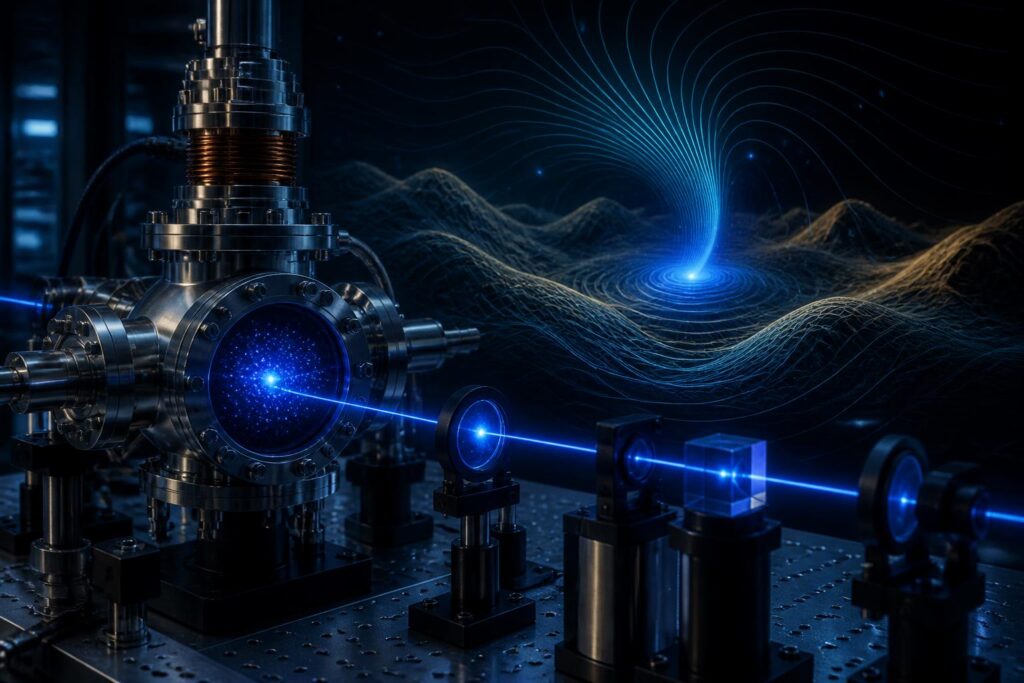
When quantum technology is mentioned, many people immediately think of computers capable of processing problems beyond the capabilities of traditional computers. But quantum computers are only one branch of a much broader picture. Another area of development that is approaching practical applications is quantum sensing: devices that use the properties of the microscopic world to measure physical quantities with very high sensitivity.
Quantum sensors do not necessarily have to perform complex calculations or replace existing servers. Their value lies in their ability to detect extremely small variations in time, magnetic fields, acceleration, gravity, temperature, or electromagnetic signals. In some fields, even a small change can provide information that conventional sensors would have difficulty capturing. Even so, high sensitivity does not mean that every quantum sensor is ready for commercialization. Devices must also operate reliably outside the laboratory, withstand vibration and noise, and have costs suitable for deployment at scale.
How Are Quantum Sensors Different from Conventional Sensors?
Every sensor has the task of turning a phenomenon in the real world into a signal that can be read and analyzed. A temperature sensor measures changes in temperature, an imaging sensor records light, and an accelerometer detects changes in motion. The difference with quantum sensors lies in the sensing element and in how quantum states are exploited.
At the level of atoms and particles, matter can exhibit properties such as superposition, interference, and discrete energy levels. If controlled well enough, these properties become an extremely sensitive form of measurement. For example, a change in a magnetic field can alter the state of an atom or the spin of a particle. By reading that change, a system can infer the strength and direction of the magnetic field.
Traditional sensors, meanwhile, generally rely on changes in components at a larger scale, such as resistors, vibrating membranes, gyroscopes, or semiconductor materials. They still offer many advantages in terms of durability, cost, and ease of integration. Quantum sensors have a clear advantage only when a problem requires the level of precision, stability, or ability to detect extremely weak signals that conventional devices cannot yet provide.
Notable Types of Quantum Sensors
Atomic Clocks and Time Measurement
Atomic clocks rely on the frequency of transitions between atomic energy levels to maintain a time standard. Because these transitions are highly stable, atomic clocks can provide the foundation for systems that require precise synchronization. Telecommunications infrastructure, positioning systems, power grids, and many distributed systems all depend on the ability to maintain consistent time.
Importantly, atomic clocks do not merely serve to display the time. In a network, accurate time helps devices determine which event occurred first, which data needs to be linked, and which signal was delayed. As clock technology becomes more compact, it can be incorporated into mobile devices or systems operating in places that cannot regularly connect to an external reference source.
Quantum Magnetometers
Quantum magnetometers measure magnetic fields by monitoring the responses of atoms, electrons, or spin states to an external field. They can be used to study materials, research brain activity, track geological changes, or assist in locating structures beneath the ground.
In biomedicine, magnetic signals generated by the body are often extremely weak and easily mixed with environmental noise. A sensitive magnetometer system can help researchers observe biological activity without introducing electric current directly into tissue. However, clinical applications require many conditions to be met simultaneously, including safety, noise reduction, simple operating procedures, and sufficient medical evidence. Therefore, a laboratory prototype should not be equated with a diagnostic device that is ready for widespread use.
Acceleration and Gravity Sensors
Quantum sensors can monitor the motion of atoms in a controlled state to infer acceleration or changes in the gravitational field. As a result, these devices have the potential to support positioning in environments without satellite signals, geological mapping, and surveys of underground structures.
Positioning that does not depend on satellites is a particularly noteworthy direction. Ships, autonomous vehicles, aircraft, or equipment operating underground may encounter areas where positioning signals are weak, obstructed, or unreliable. If quantum inertial sensors achieve the necessary stability in a compact device, they could complement current positioning methods. Nevertheless, errors still accumulate over time, while the system must handle vibration and complex motion in real-world conditions.
Why Can Quantum Sensors Make a Difference?
The core advantage comes from the fact that quantum states respond very sensitively to their environment. This sensitivity is both an opportunity and a problem. A small variation that needs to be measured can produce a sufficiently large change in the readout signal, but unwanted effects such as heat, vibration, scattered light, or external magnetic fields can also distort the measurement.
In many designs, researchers must isolate the quantum system from its environment to protect the state being observed. They may use vacuum chambers, magnetic shielding, stable optical systems, or temperature-control mechanisms. These measures improve measurement quality but also make devices larger, more expensive, and harder to maintain. The commercial challenge is therefore not merely to achieve the highest possible sensitivity, but to find a balance among sensitivity, size, power consumption, measurement speed, and durability.
The Gap Between the Laboratory and the Product
A prototype can produce impressive results in a tightly controlled environment. A commercial product, by contrast, must operate amid mechanical noise, changing temperatures, imperfect power supplies, and non-specialist users. This gap is often greater than what technology announcements may lead the public to imagine.
The first challenge is system miniaturization. Many quantum sensors require lasers, vacuum chambers, electronic control equipment, and signal-processing software. Integrating these components into a compact, lightweight module requires new designs, suitable materials, and stable manufacturing processes. An overly bulky device may be suitable only for research centers, while a smaller device may have to trade away some performance.
The second challenge is calibration and data interpretation. A sensor’s sensitivity does not automatically translate into useful information. Operators need to know whether a signal comes from the phenomenon being measured or from environmental noise. The data must also be combined with maps, physical models, or other sensors. In many cases, a hybrid system combining quantum and conventional sensors will be more practical than completely eliminating older technology.
The third challenge is economic value. A more accurate sensor is worth investing in only when it helps reduce survey costs, detect risks earlier, improve safety, or enable something that was previously impossible. If that benefit is not sufficiently clear, businesses will continue choosing conventional devices with lower prices and existing maintenance networks.
Fields That May Benefit
In geology and construction, gravity sensors could help identify changes in underground density, thereby supplementing surveying activities. In transportation, inertial sensors could help vehicles maintain position estimates when external signals are interrupted. In energy, magnetic-field measurements and precise timing could support equipment monitoring, power-grid synchronization, or materials research.
Biomedicine is a field with potential, but it also requires caution. Quantum sensors could provide tools for studying weak biological signals, but a research device is not the same as a validated diagnostic method. Testing procedures, patient protection, and the reproducibility of results remain mandatory requirements.
Security and defense are often mentioned in discussions of quantum sensors because of their potential to detect signals or measure motion under constrained conditions. However, these are sensitive applications subject to regulations and security requirements. Discussions of technical potential should be kept separate from claims that a technology has already achieved broad deployment capability.
Do Not Confuse Quantum Sensors with Quantum Computers
These two technologies are both based on quantum mechanics, but they have different objectives. Quantum computers use quantum states to encode and process information according to a new computational model. Quantum sensors use quantum states as references or sensing elements to detect changes in the environment.
This distinction matters when assessing the maturity of the technology. A quantum sensor can be deployed for a specialized task without waiting for general-purpose quantum computers to reach a large scale. Conversely, sensors are not an automatic path to a powerful quantum computer. The two directions may share some control techniques, materials, or components, but their engineering problems and success criteria are not the same.
A Realistic View of the Future
Quantum sensors are likely to appear first in specialized markets, where the value of precise measurement is high enough to justify the investment cost. Research centers, critical infrastructure, geological surveying, and certain biomedical devices may be among the places where the technology is validated first. Only later, as components become standardized and gradually smaller, will opportunities for broader applications emerge.
Users and businesses should evaluate products based on specific tasks rather than simply looking at the quantum label. They should ask about sensitivity under real-world conditions, stability over time, calibration requirements, data-integration capabilities, operating costs, and replacement options if the device fails. A conventional sensor may still be the better choice if it meets the requirements sufficiently with a simpler process.
The notable feature of quantum sensors does not lie in the promise that they will replace every existing measuring device. Their practical value lies in areas where the world remains too obscure for conventional tools: a small geological variation, a weak biological signal, an accumulated timing deviation, or a movement occurring in an information-poor environment. When developers solve the problems of operation and cost, quantum sensors could become a new layer of observation, quietly supplementing the measurement infrastructure already in place.
